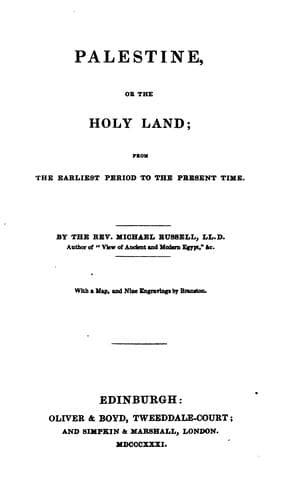
Palestine, or, the Holy Land: From the Earliest Period to the Present TimeRussell, Michael
History
Palestine, or, the Holy Land: From the Earliest Period to the Present Time
Russell, Michael
Palestine -- Description and travel; Palestine -- History
The tide of success flowed for some time so strongly in favour of the
Christians, that the Saracen leaders were desirous to conclude a peace
very advantageous to their invaders. When the loss of Damietta appeared
inevitable, the Sultan of Syria, Khamel, the son of Saphadin, apprehensive
that the Crusaders would immediately advance against Jerusalem, issued
orders to destroy the fortifications, to prevent its being held by them as
a place of defence. But in the negotiation which was opened between the
contending powers, the Mussulmans consented to rebuild the walls of the
sacred city, to return the portion of the true cross, and to liberate all
the prisoners in Syria and Egypt. Of the whole kingdom of Palestine, they
proposed to retain only the castles of Karac and Montereale, as necessary
for the safe passage of pilgrims and merchants in their intercourse with
Mecca. As an equivalent for these important concessions, they required
nothing more than the instant evacuation of Egypt, and a complete
relinquishment of the conquests which had been recently made in it by the
arms of the Crusaders.
The Christian chiefs, after a stormy discussion, determined to reject the
terms offered by the allied sultans, and to prosecute the siege of
Damietta. This devoted town, having been invested more than a year and a
half, was at length carried by assault; but so resolute and persevering
had been the defence, that of seventy thousand inhabitants, who were shut
up by the Crusaders, only three thousand remained to witness their
triumph.
The Saracens, fatigued with the horrors of war, once more proposed a
treaty on terms similar to those which were offered before the fall of
Damietta. But the victors, whose wisdom in council was never equal to
their valour in the field of battle, again refused to conclude a peace.
The prevailing party recommended an immediate attack upon Grand Cairo;
anticipating the reduction of the whole of Egypt, and the final subjection
of all the Mahommedan states on the shores of the Mediterranean. This
vision of greatness, however, soon vanished before the real difficulties
of a campaign on the banks of the Nile. In a few months the leaders of the
expedition found themselves reduced to the necessity of soliciting
permission to return into Palestine; consenting to purchase safety by
giving up all the acquisitions they had made since the first day that they
opened their trenches before Damietta. The barons of Syria and the
military orders retired to Acre, where they held themselves in readiness
to sustain an attack from the indignant Moslems; the mass of the
volunteers and pilgrims soon afterward procuring the means of returning
into Europe.
Public-domain text, read in full here on John Shaqi.
Reviews
Reviews
No reviews yet
Be the first to share your thoughts on this work.
Elsewhere in the archive
Join the Discussion
Join the discussion
Sign in to leave a comment or review.
Sign InorCreate an account