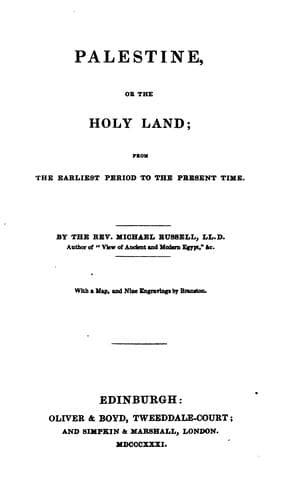
Palestine, or, the Holy Land: From the Earliest Period to the Present TimeRussell, Michael
History
Palestine, or, the Holy Land: From the Earliest Period to the Present Time
Russell, Michael
Palestine -- Description and travel; Palestine -- History
But these unseemly disputes were soon drowned amid the shouts of a more
formidable warfare waged against Palestine by the Mamlouk sovereign of
Egypt, the sanguinary and bigoted Bibars. His troops demolished the
churches of Nazareth and Mount Tabor; after which they advanced to the
gates of Acre, inflicting the most horrid cruelties upon the unprotected
Christians. Sephouri and Azotus were taken by storm, or yielded upon
terms. At the reduction of the former, it was agreed that the knights and
garrison, amounting in all to six hundred men, should be conducted to the
nearest Christian town. But no sooner was the sultan put in possession of
the fortress than he violated the conditions of surrender, and left the
knights only a few hours to determine on the alternative of death or
conversion to Islamism. The prior and two Franciscan monks succeeded by
their exhortations in fixing the faith of the religious cavaliers; and
hence, at the time appointed for the declaration of their choice, they
unanimously avowed their resolution to die rather than incur the dishonour
of apostacy. The decree for the slaughter of the Templars was pronounced
and executed; while the three preachers of martyrdom, as if responsible
for the conduct of their countrymen, were flayed alive.
A large Christian state had been formed at Antioch, in alliance with the
kingdom of Jerusalem. Bibars, after reducing Jaffa and the castle of
Beaufort, marched his fierce soldiers against the capital of Syria, and
soon added it to the number of his conquests. Forty thousand believers is
Christ were on this occasion put to the sword, and not fewer than one
hundred thousand were led into captivity. The barbarian, indeed, avowed
the fell purpose of exterminating the whole Christian community in the
East, extending the terror of death or the ascendency of the Koran from
the Nile to the mountains of Armenia. But his progress was stopped by the
intelligence which reached him in Palestine, that the King of Cyprus had
resolved to interpose his arms in behalf of the Holy Land, and was about
to make a descent on the coast at the head of a large force collected from
various nations. Bibara returned to Cairo, fitted out a fleet for the
conquest of that island, and intended, during the absence of its
sovereign, to annex it permanently to the dominions of Egypt. But his
ships were lost in a tempest; his military character suffered from the
failure of the enterprise; his power was weakened; and he ceased to be any
longer the scourge and dread of the Christian world.
Public-domain text, read in full here on John Shaqi.
Reviews
Reviews
No reviews yet
Be the first to share your thoughts on this work.
Elsewhere in the archive
Join the Discussion
Join the discussion
Sign in to leave a comment or review.
Sign InorCreate an account