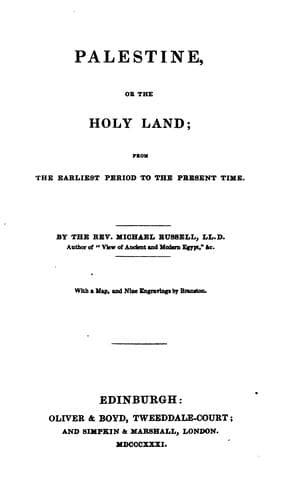
Palestine, or, the Holy Land: From the Earliest Period to the Present TimeRussell, Michael
History
Palestine, or, the Holy Land: From the Earliest Period to the Present Time
Russell, Michael
Palestine -- Description and travel; Palestine -- History
Prince Edward, who condemned the vacillating conduct of his allies, had
already passed from Africa into Sicily, where he spent the following
winter. In the early part of the year 1271, he set sail for Acre, where he
landed at the head of only one thousand men; but so high was his
reputation among the Latins of Palestine, that he soon found his army
increased sevenfold, and eager to be employed in the redemption of the
sacred territory. He led them, in the first place against Nazareth, which
did not long resist the vigour of his attack; and, almost immediately
afterward, he surprised a large Turkish force, whom he cut in pieces The
Moslems imagined that another Coeur de Lion had been sent from England to
scourge them into discipline, or to shake the foundation of their power in
Syria. Edward was brave and skilful as a warrior, and owed his success not
less to his able dispositions than to his personal courage. But he was
cruel and lavish of human blood. The barbarities which disgraced the
triumphs of the first Crusade were repeated on a smaller scale at
Nazareth, where the prince put the whole garrison to death, and subjected
the inhabitants to unnecessary suffering.
The resentment of the governor of Jaffa is said to have pointed the dagger
which was aimed at the heart of the English prince by the hand of an
assassin. The wretch, as the bearer of letters, was admitted into the
chamber of Edward, who, not suspecting treachery, received several severe
wounds before he could dash the assailant to the floor and despatch him
with his sword. But as the weapon used by the Saracen had been steeped in
poison, the life of his intended victim was for some hours in imminent
danger. The chivalrous fiction of that romantic age has ascribed his
recovery to the kind offices of one of that sex whose generous affections
are seldom chilled by the calculations of selfishness. His wife, Eleanora,
is said to have sucked the poison from his wound, at the hazard of instant
death to herself,--a story which, having received the sanction of the
learned Camden, has not unfrequently been held as an indisputable fact.
The more authentic edition of the narrative attributes the restoration of
Edward's health to the usual means employed by surgical skill, aided by
the resources of a strong mind and a vigorous constitution.[179]
It soon became manifest that the valour and ability of Edward, unsupported
by an adequate force, could make no lasting impression upon the Moslem
power in Syria. Accordingly, after having spent fourteen months in Acre,
he listened to proposals for peace made by the Sultan of Egypt, who, being
engaged in war with the Saracens whom he had displaced, was eager to
terminate hostilities with the English. A suspension of arms, to continue
ten years, was formally signed by the two chiefs; whereupon the Mamlook
withdrew his troops from Palestine, and Edward embarked for his native
country.
Public-domain text, read in full here on John Shaqi.
Reviews
Reviews
No reviews yet
Be the first to share your thoughts on this work.
Elsewhere in the archive
Join the Discussion
Join the discussion
Sign in to leave a comment or review.
Sign InorCreate an account