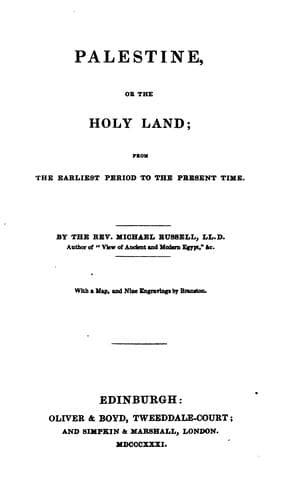
Palestine, or, the Holy Land: From the Earliest Period to the Present TimeRussell, Michael
History
Palestine, or, the Holy Land: From the Earliest Period to the Present Time
Russell, Michael
Palestine -- Description and travel; Palestine -- History
The winds in Palestine, as in all countries which approach the tropics,
are periodical, and governed in no small degree by the course of the sun.
About the autumnal equinox, the north-west begins to blow with frequency
and strength. It renders the air dry, clear, and sharp; and it is
remarkable that on the seacoast it causes the headache, like the
north-east wind in Egypt. We may further observe, that it usually blows
three days successively, like the south and south-east at the other
equinox. It continues to prevail till November, that is, about fifty
days, when it is followed by the west and south-west, called by the Arabs
"the fathers of rain." In March arise the pernicious winds from the
southern quarter, with the same circumstances as in Egypt; but they
become feebler as we advance towards the north, and are much more
supportable in the mountains than in the low country. Their duration at
each return varies from twenty-four hours to three days. The easterly
winds, which come next in order, continue till June, when they are
commonly succeeded by an inconstant breeze from the north. At this season
the wind shifts through all the points every day, passing with the sun
from east to south, and from south to west, to return by the north and
recommence the same circuit. At this time, too, a local wind, called the
land-breeze, prevails along the coast during the night; it springs up
after sunset, lasts till the appearance of the solar orb in the morning,
and extends only a few leagues to sea.
Travellers have observed that thunder, in the lowlands of Palestine as
well as in Egypt, is more common during the winter than in summer; while
in the mountains, on the contrary, it is more frequent in the latter
season, and very seldom heard in the former. In both these countries it
happens oftenest in the rainy season, or about the time of the equinoxes,
especially the autumnal; and it is further remarkable that it never comes
from the land side, but always from the sea. These storms, too, generally
speaking, take place either in the evening or morning, and rarely in the
middle of the day. They are accompanied with violent showers of rain, and
sometimes of uncommonly large hail, which, soon covering the face of the
country with stagnant water, give rise to a copious evaporation.
The phenomenon alluded to by the prophet Elijah is still found to
diversify the aspect of the eastern sky. Volney remarks, that clouds are
sometimes seen to dissolve and disperse like smoke; while on other
occasions they form in an instant, and from a small speck increase to a
prodigious size. This is particularly observable at the summit of
Lebanon; and mariners have usually found that the appearance of a cloud
on this peak is an infallible presage of a westerly wind, one of the
"fathers of rain" in the climate of Judea.[191]
Public-domain text, read in full here on John Shaqi.
Reviews
Reviews
No reviews yet
Be the first to share your thoughts on this work.
Elsewhere in the archive
Join the Discussion
Join the discussion
Sign in to leave a comment or review.
Sign InorCreate an account