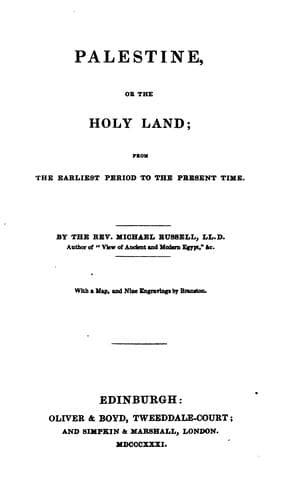
Palestine, or, the Holy Land: From the Earliest Period to the Present TimeRussell, Michael
History
Palestine, or, the Holy Land: From the Earliest Period to the Present Time
Russell, Michael
Palestine -- Description and travel; Palestine -- History
The wild _ass_, or para, celebrated by the same ancient author, is
generally understood to be the onager, an animal, which is to this day
highly prized in Persia and the deserts of Tartary, as being fitter for
the saddle than the finest breed of horses. It has nothing of the dulness
or stupidity of the common ass; is extremely beautiful; and, when
properly trained, is docile and tractable in no common degree. It was
this more valuable kind of ass that Saul was in search of when he was
chosen by the prophet to discharge the duties of royalty. "Who hath sent
out the wild ass free? or who hath loosed the bands of the wild ass?
whose house I have made the wilderness, and the barren land his
dwellings. He scorneth the multitude of the city, neither regardeth he
the crying of the driver. The range of the mountains is his pasture, and
he searcheth after every green thing."[196]
The "wild goats of the rock," described in the chapter just quoted, are
supposed to be the same as the ibex or bouquetin. This animal is larger
than the tame goat, but resembles it much in form. The head is small is
proportion to the body, with the muzzle thick and compressed, and a
little arced. The eyes are large and round, and have much fire and
brilliancy. The horns are so majestic, that when fully grown they
occasionally weigh sixteen or eighteen pounds. He feeds during the night
in the highest woods; but the sun no sooner begins to gild the summits,
than he quits the woody region, and mounts, feeding in his progress, till
he has reached the most considerable heights. The female shows much
attachment to her young, and even defends it against eagles, wolves, and
other enemies. She takes refuge in some cavern, and, presenting her head
at the entrance of the hole, resolutely opposes the assailants. Hence the
allusion to this affectionate creature in the book of Proverbs, "Let thy
wife be as the loving hind and the peasant roe."
The saphan of the Bible is usually translated _cony_. "The high hills are
a refuge for the wild goats, and the rocks for the conies." But it is now
believed that the ashkoko, an animal mentioned by Bruce, presents
properties which accord much better with the description of the saphan
given in different parts of the Old Testament, than the cony, hare, or
rabbit. This curious creature, we are told by that traveller, is found in
Ethiopia, in the caverns of the rocks, or under great stones. It does not
burrow or make holes like the rat or rabbit, nature having interdicted
this practice by furnishing it with feet, the toes of which are perfectly
round, and of a soft, pulpy, tender substance: the fleshy part of them
projects beyond the nails, which are rather sharp, very similar to a
man's nails ill-grown, and appear given to it rather for the defence of
its soft toes, than for any active use in digging, to which they are by
no means adapted.[197]
Public-domain text, read in full here on John Shaqi.
Reviews
Reviews
No reviews yet
Be the first to share your thoughts on this work.
Elsewhere in the archive
Join the Discussion
Join the discussion
Sign in to leave a comment or review.
Sign InorCreate an account