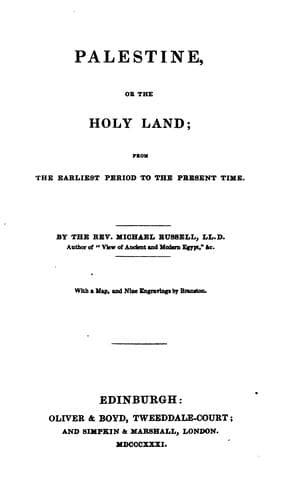
Palestine, or, the Holy Land: From the Earliest Period to the Present TimeRussell, Michael
History
Palestine, or, the Holy Land: From the Earliest Period to the Present Time
Russell, Michael
Palestine -- Description and travel; Palestine -- History
In the book of Deuteronomy there is an allusion made to a destructive
creature in the following terms:--"Their wine is the poison of _dragons_
and the cruel venom of asps." It is thought that the gecko is the animal
contemplated in this description, it being acknowledged by all
naturalists to contain a mortal poison. Nature, in this instance, says
Buffon, appears to act against herself: in a lizard, whose species is but
too prolific, she exalts a corrosive liquid to such a degree as to carry
death and dissolution into all living substances which it may happen to
penetrate. This deadly reptile has some resemblance to the chameleon; his
head, almost triangular, is big in proportion to his body; the eyes are
very large, the tongue is flat, covered with small scales, and the end is
rounded; the teeth are sharp, and so strong that, according to Bontius,
they are able to make an impression even on steel. The gecko is almost
entirely covered with large warts, more or less rising; the under part of
the thigh is furnished with a row of tubercles raised and grooved. The
feet are remarkable for oval scales, more or less hollowed in the middle,
as large as the under surface of the toes themselves, and regularly
disposed over one another, like slates on a roof. The usual colour of
this animal is a clear green, spotted with brilliant red. It inhabits the
crevices of half-rotten trees as well as humid places; it is sometimes
met with in houses, where it occasions great alarm, and where every
exertion is made to destroy it speedily. Bontius writes, that the bite is
so venomous that, if the part bitten be not cut away or burned, death
ensues in a few hours.
Calmet enumerates eleven kinds of serpents as known to the Hebrews, the
names of which are as follow:--
1. Ephe, the viper.
2. Chephir, a sort of aspic.
3. Acshub, the aspic.
4. Pethen, a similar reptile.
5. Tzeboa, speckled serpent.
6. Tzimmaon.
7. Tzepho, or Tzephoni, a basilisk.
8. Kippos, the acontias.
9. Shephiphon, the cerastes.
10. Shachal, the black serpent.
11. Saraph, a flying-serpent.
The first of these is remarkable for its quick and penetrating poison; it
is about two feet long, and as thick as a man's arm, beautifully spotted
with yellow and brown, and sprinkled over with blackish specks, similar
to those of the horn-nosed snake. It has a wide mouth, by which it
inhales a great quantity of air, and, when fully inflated, ejects it with
such violence as to be heard at a considerable distance.
Public-domain text, read in full here on John Shaqi.
Reviews
Reviews
No reviews yet
Be the first to share your thoughts on this work.
Elsewhere in the archive
Join the Discussion
Join the discussion
Sign in to leave a comment or review.
Sign InorCreate an account