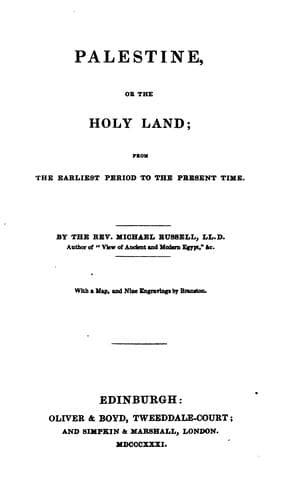
Palestine, or, the Holy Land: From the Earliest Period to the Present TimeRussell, Michael
History
Palestine, or, the Holy Land: From the Earliest Period to the Present Time
Russell, Michael
Palestine -- Description and travel; Palestine -- History
The author just named, describes the "balsam of Aaron" as a very fine
oil, which emits no scent or smell, and is very proper for preparing
odoriferous ointments. It is obtained from a tree called behen, which
grows in Mount Sinai and Upper Egypt, and, it is presumed, in certain
parts of the Holy Land. Travellers assert that it is the very perfume
with which the ancient high-priest of the Jews, with whose name it is
connected, was wont to anoint his beard, and which the Psalmist extols so
much on account of its rich odour and mollifying qualities,--the emblem
of domestic harmony and brotherly love.
There still exists a thorn in Palestine known among botanists by the name
of the "spina Christi," or thorn of Christ, and supposed to be the shrub
which afforded the crown worn by our Saviour before his crucifixion. It
must have been very fit for the purpose, for it has many small sharp
prickles, well adapted to give pain; and as the leaves greatly resemble
those of ivy, it is not improbable that the enemies of the Messiah chose
it from its similarity to the plant with which emperors and generals were
accustomed to be crowned; and hence that there might be calumny, insult,
and derision, meditated in the very act of punishment.[208]
THE END.
[1] No. XXIII. of this Family Library.
[2] See Dialogues on Natural and Revealed Religion. By the Rev. Robert
Morehead, D.D., p. 241,--an able and interesting work.
[3] Shakspeare, Henry IV. Part I. Act I.
[4] Chateaubriand Itinéraire, tome i. p. 48, &c. Sozom. lib. iii. c. i.
Euseb. Hist. Eccl. lib. vi. S. Cyril, Cat. xvi.
[5] Deuteronomy viii. 7, 8, 9.
[6] Terra finesque, qua ad Orientem vergunt, Arabia terminantur; a meridie
Aegyptus objacet; ab occasu Phoenices et mare; septemtrionem a latere
Syriae longe prospectant. Corpora hominum salubria et ferentia laborom:
rari imbres, uber solum: fruges nostrum ad morem; preterque eas balsamum
et palmae. Hist. lib. v. c. 6.
[7] Belon. Observations de Singularités, p. 140. Hasselquist's Travels,
p.56. Korte's Travels in Palestine. Chateaubriand, les Martyrs, vol. iii.
p. 99. Schultze's Travels, vol. ii p. 85.
[8] Seetzen, in Annales des Voyages, i. 398; and Correspondance de M.
Zach. 425.
[9] Maundrell, p. 60.
[10] Chateaubriand Itinérarie, ii. 123. Malte Brun, vol. ii. 150-160.
Edin. Edition.
[11] Judges i. 3.
[12] Joseph. contra Apion. cap. 1. 2 Kings xvii. 24.
[13] Reland, Palestina Illustrata, lib. ii. c. 5. Spanheim, Charta terris
Israelis. Lowman on the Civil Government of the Hebrews.
[14] Lev. xxv. 23.
[15] Lev. xxv. 24-28.
[16] Judges xxi. 8-13.
[17] Numbers xxvi. 02.
[18] Joshua vii. 16, 17, 18.
[19] I Chron. ii. 10, 11.
[20] Deut. iv. 1, 2; xii. 32. "Hoc igitur argumento maximo est; juris
illius majestatis quod in legibus ferendis est positum, nihil quicquam
penes hominem fuisse."--_Conringius de Repub. Heb_.
[21] Livii. Hist. lib. xxviii. 37; lib. xxx. 7. Bochart, Geog. Sacra, part
ii. lib. ii. 24.
Public-domain text, read in full here on John Shaqi.
Reviews
Reviews
No reviews yet
Be the first to share your thoughts on this work.
Elsewhere in the archive
Join the Discussion
Join the discussion
Sign in to leave a comment or review.
Sign InorCreate an account