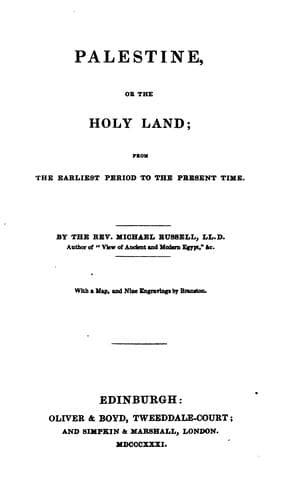
Palestine, or, the Holy Land: From the Earliest Period to the Present TimeRussell, Michael
History
Palestine, or, the Holy Land: From the Earliest Period to the Present Time
Russell, Michael
Palestine -- Description and travel; Palestine -- History
"She's gone, who shared my diadem;
She sunk, with her my joys entombing;
I swept that flower from Judah's stem
Whose leaves for me alone were blooming;
And mine's the guilt, and mine the hell,
This bosom's desolation dooming;
And I have earned those tortures well,
Which unconsumed are still consuming."
_Hebrew Melodies_.
[48] History of the Jews, vol. ii. p. 96.
[49] Matth. ii. 22, 23. "Among the atrocities which disgraced the later
days of Herod, what we called the Massacre of the Innocents (which took
place late in the year before, or early in the same year with the death of
Herod) passed away unnoticed. The murder of a few children in a village
near Jerusalem would excite little sensation among such a succession of
dreadful events, except among the immediate sufferers. The jealousy of
Herod against any one who should be Born as a _king in Judea_,--the dread
that the high religious spirit of the people might be re-excited by the
hope of a real Messiah,--as well as the summary manner in which he
endeavoured to rid himself of the object of his fears, are strictly
in accordance with the relentlessness and decision of his character."
_History of the Jews_, vol. ii. p. 106.
[50] Acts xii. 21, 22, 23.
[51] 1 Samuel, ix. 5 11.
[52] 1 Kings xxii. 8, 13.
[53] Jer. xxvi. 8, 16.
[54] Deut. xviii. 21, 22.
[55] Deut. xxxi. 9-14.
[56] 2 Chronicles xii. 9.
[57] 2 Kings xxii. 8.
[58] 2 Samuel xi. 18, 22. Commentaries on Laws of Moses, vol. i. p. 257.
[59] Nisan was sometimes called Abib, as descriptive of the state of
vegetation in that month,--the earing of the corn and the blooming of the
fruit-trees.
[60] 1 Kings iii. 2.
[61] Acts xv. 21.
[62] Deut. xvi. 9-12.
[63] History of the Jews vol. 1. p. 99.
[64] Lev. xiii. 24, 25.
[65] Numbers xxxvi. 1-10.
[66] John x. 22.
[67] Maccab. iv. 30, &c. 2 Macceb. i. 18, 19.
[68] Croxall's Scripture Politics, p. 60, 85. Histoire des Hébreux, par
Rabelleau, tom. i. p. 405. Esprit de l'Histoire, tom. i. p. 28.
[69] The sentiment contained in the text is beautifully expressed in the
following ode by Lord Byron:
I.
"The harp the monarch minstrel swept,
The king of men, the loved of Heaven,
Which music hallowed while she wept,
O'er tones her heart of hearts had given,
Redoubled be her tears, its chords are riven!
"It softened men of iron mould,
It gave them virtues not their own;
No ear so dull, no soul so cold,
That felt not, fired not to the tone,
Till David's lyre grew mightier than his throne."
II.
"It told the triumphs of our king,
It wafted glory to our God;
It made our gladden'd valleys ring,
The cedars bow, the mountains nod;
Its sound aspired to heaven and there abode!
Since then, though heard on earth no more,
Devotion and her daughter Love
Still bid the bursting spirit soar
To sounds that seem as from above,
In dreams that day's broad light cannot remove."
Public-domain text, read in full here on John Shaqi.
Reviews
Reviews
No reviews yet
Be the first to share your thoughts on this work.
Elsewhere in the archive
Join the Discussion
Join the discussion
Sign in to leave a comment or review.
Sign InorCreate an account