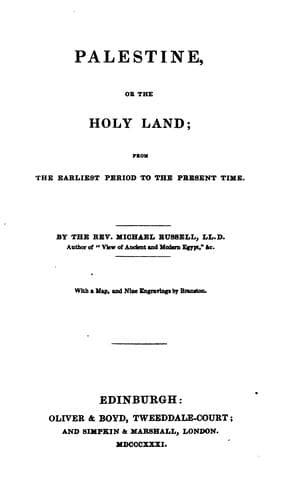
Palestine, or, the Holy Land: From the Earliest Period to the Present TimeRussell, Michael
History
Palestine, or, the Holy Land: From the Earliest Period to the Present Time
Russell, Michael
Palestine -- Description and travel; Palestine -- History
Old Sandys, a simple and amusing writer, describes Jerusalem as
follows:--"This chic, once sacred and glorious, elected by God for his
seate, and seated in the midst of nations,--like a diadem crowning the
head of the mountaines,--the theatre of mysteries and miracles,--was
founded by Melchisedek (who is said to be the son of Noah, and that
not unprobably) about the year of the world 2023, and called Salem
(by the Gentiles Solyma), which signifyeth Peace: who reigned here
fifty years.--This citie is seated on a rockie mountaine; every way
to be ascended (except a little on the north) with steep ascents and
deep valleys naturally fortified; for the most part environed with
other not far removed mountaines, as if placed in the midst of an
amphitheatre."--Lib. iii. p. 154.
[101] "Bethlehem soon after came in sight,--a fine village, surrounded
with gardens of fig-trees and olives. There is a deep valley below, and
half-way down on the top of a hill is a green plain, the only one we have
seen in Judea:--I could fancy Boaz's field forming part of it. The convent
is a very remarkable building, and well worth seeing. Without, it is a
perfect fortress, with heavy buttresses and small grated windows, on
entering, we immediately came to a magnificent church, with a double row
of ten Corinthian pillars of marble on each side,--forty pillars to all.
On the arched roof are the remains of Mosaic, of the Empress Helena's
time. One part was very distinct: it represented a city with temples, &c.,
and over it was written in Greek characters, _Laodicea_."--_Anonymous
Journal_.
[102] Richardson, Buckingham, Maundrell.
[103] Bethleem nunc nostram, et augustissimum urbis locum de quo Psalmista
canit (Ps. lxxxiv. 12). _Veritas de terra orta est_, lucus inumbrabat
Thamus, id est, Adonidis; et in specu ubi quondam Christus parvulus
vagiit, Veneris Amasius plangebatur.--_Epis. ad Paul_.
Public-domain text, read in full here on John Shaqi.
Reviews
Reviews
No reviews yet
Be the first to share your thoughts on this work.
Elsewhere in the archive
Join the Discussion
Join the discussion
Sign in to leave a comment or review.
Sign InorCreate an account