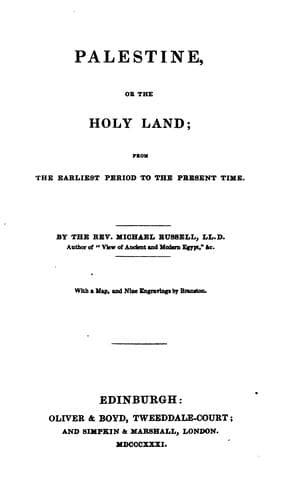
Palestine, or, the Holy Land: From the Earliest Period to the Present TimeRussell, Michael
History
Palestine, or, the Holy Land: From the Earliest Period to the Present Time
Russell, Michael
Palestine -- Description and travel; Palestine -- History
[150] The following extract from the unpublished journal already so often
referred to will amuse the reader:--"We arrived at the foot of Mount
Tabor. It is, in its general outline, a round, regular-shaped hill, but is
rocky and rough enough when it is to be ascended. It has many trees,
mostly Valonia oaks. It stands on the east of the great Plain of
Esdraëlon, up a recess formed by Mount Hermon on the one side, and the
hills towards Nazareth on the other. Its height from the plain I should
guess at 1000 feet. We ascended the greater part of the way on mules. On
the top of the hill is one of those large cisterns, or granaries, so often
alluded to before. There was one also near Jennin, which we observed in
coming in. I have since seen them in numerous other places, which puts an
end to Dr. Clarke's pagan remains. The whole of the Great Plain is fully
cultivated, yet we could hardly see a single village, which adds to the
peculiarity of its appearance,--one sheet of cultivation without a rock or
tree".
[151] Clarke, vol. iv. p. 260. Doubdan, Voyage de la Terre Sainte, p. 507.
Paris, 1661.--It is remarkable that all the descriptions of the view from
Mount Tabor appear to be borrowed from this sedulous Frenchman, whose
work, in point of topography, is still unequalled.
[152] Journey, p. 112.
[153] Clarke, vol. iv. p. 170.
[154] Vol. iv. p. 174. "Up stairs, above the Chapel of the Incarnation,"
says Dr. Richardson, "we were shown another grotto, which was called the
Virgin Mary's Kitchen, and a black smoked place in the corner which was
called the Virgin Mary's Chimney. I believe none of the cinders,
fire-irons, or culinary instruments have been preserved; these probably
fled with the Santa Casa, or Holy House, to Loretto; and our only
astonishment is, that the house should have taken flight and left the
chimney and kitchen behind."--vol. ii. p. 440.
[155] Luke iv. 28, 29, 30.
[156] Travels in Palestine, vol. ii. p. 315.
[157] "Traditio continua est, et nunquam interrupta, apud omnes nationes
Orientales, hanc petram, dictam Mensa Christi, iliam ipsam esse supra quam
Dominus noster Jesus Christus cum suis comedit discipulis ante et post
suam resurrectionem a mortuis.
"Et sancta Romana ecclesia INDULGENTIAM concessit septem annorum et
totidem quadragenarum, omnibus Christi fldelibus hunc sanctum locum
visitantibus, recitando saltem ibi unum Pater, et Ave, dummodo sint in
statu gratiae."
"It is a continued and uninterrupted tradition among all the Eastern
churches, that this stone, called the Table of Christ, is that very one
upon which our Lord Jesus Christ ate with his disciples both before and
after his resurrection from the dead.
"And the holy Roman church hath granted an INDULGENCE of seven years, and
as many lents, to all the faithful in Christ visiting this sacred place,
upon reciting at least one Pater Noster and an Ave, provided they be in a
state of grace."
[158] Clarke, vol. iv. p. 167.
Public-domain text, read in full here on John Shaqi.
Reviews
Reviews
No reviews yet
Be the first to share your thoughts on this work.
Elsewhere in the archive
Join the Discussion
Join the discussion
Sign in to leave a comment or review.
Sign InorCreate an account