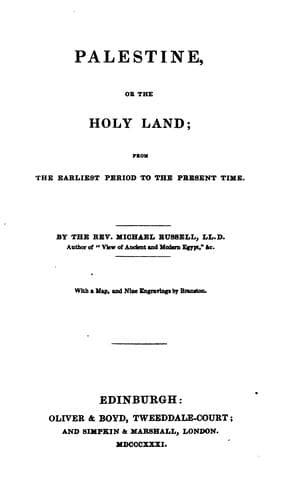
Palestine, or, the Holy Land: From the Earliest Period to the Present Time — John Shaqi
Palestine, or, the Holy Land: From the Earliest Period to the Present TimeRussell, Michael
History
Palestine, or, the Holy Land: From the Earliest Period to the Present Time
Russell, Michael
Palestine -- Description and travel; Palestine -- History
Every reader of the Bible is aware, that six of these cities were invested
with the special right of affording refuge and protection to a certain
class of criminals. The Jewish doctors maintain that this privilege,
somewhat limited, belonged to all the forty-eight; for, being sacred, no
act of revenge or mortal retaliation was permitted to take place within
their gates. Into the six cities of refuge, properly so called, the
manslayer could demand admittance, whether the Levites were disposed to
receive him or not; and on the same ground he was entitled to gratuitous
lodging and maintenance, until his cause should be determined by competent
judges. It is added, that they could exercise a discretionary power as to
the reception of a homicide into any other of their cities, and even in
respect to the hire which they might demand for the house used by him
during temporary residence. But the institution of Moses, afterward
completed by Joshua, affords no countenance to these rabbinical
distinctions; and we have no reason whatever to believe that the benefit
of asylum was granted to any Levitical town besides Hebron, Shechem,
Ramoth, Bezer, Kedesh, and Golan.[31]
As learning and the several professions connected with the knowledge
of letters were confined almost exclusively the tribe of Levi, the
distribution of its members throughout the whole of the Hebrew
commonwealth was attended with many advantages. Every Levitical city
became at once a school and a seat of justice. There the language, the
traditions, the history, and the laws of their nation were the constant
subjects of study, pursued with that zeal and earnestness which can only
arise from the feeling of a sacred obligation, combined with the impulse
of an ardent patriotism. Within their walls were deposited copies of their
religious, moral, and civil institutions; which it was their duty not only
to preserve, but to multiply. They kept, besides, the genealogies of the
tribes; in which they marked the lineage of every family who could trace
their descent to the father of the faithful. Being carefully instructed
in the law, and possessed of the annals of their people from the earliest
days, they were well qualified to supply the courts with magistrates and
scribes, men who were fitted not only to administer justice, but also to
frame a record of all their decisions. It is perfectly clear that, in
the reign of David and of the succeeding kings, the judges and other
legal officers were selected from among the Levites; there being in
those days not fewer than six thousand of this learned body who held
such appointments.
Public-domain text, read in full here on John Shaqi.
Reviews
Reviews
No reviews yet
Be the first to share your thoughts on this work.
Join the Discussion
Join the discussion
Sign in to leave a comment or review.
Sign InorCreate an account