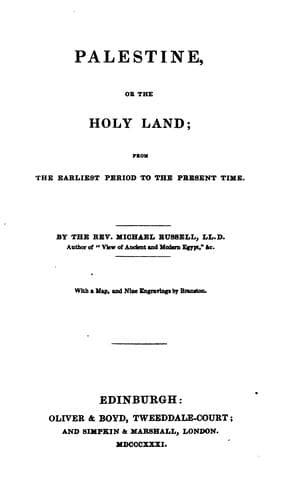
Palestine, or, the Holy Land: From the Earliest Period to the Present TimeRussell, Michael
History
Palestine, or, the Holy Land: From the Earliest Period to the Present Time
Russell, Michael
Palestine -- Description and travel; Palestine -- History
Michaelis represents the Levitical law among the Hebrews in the light of
a literary noblesse; enjoying such a degree of wealth and consideration
as to enable them to act as a counterpoise to the influence of the
aristocracy; while, on the other hand they prevented the adoption of
those hasty measures which were sometimes to be apprehended from the
democratical nature of the general government. They were not merely a
spiritual brotherhood, but professional members of all the different
faculties; and by birth obliged to devote themselves to those branches
of study, for the cultivation of which they were so liberally rewarded.
Like the Egyptian priesthood, they occupied the whole field of literature
and science; extending their inquiries to philosophy, theology, natural
history, mathematics, jurisprudence, civil history, and even medicine.
Perhaps, too, it was in imitation of the sages of the Nile that the
Hebrews made these pursuits hereditary in a consecrated tribe; whence
flowed this obvious advantage, that the sons of the Levites, from the
very dawn of reason, were introduced to scientific researches, and
favoured with a regulated system of tuition suited to the occupation
in which their lives were to be spent. In short, the institution bears
upon it all the marks of that wisdom for which the Mosaical economy is
so remarkably distinguished, when viewed as the basis of a government
at once civil, religious, and political.[32]
The youngest reader of the Sacred Volume cannot fail to have perceived,
that the character and government of the Hebrew judges withdraw the
attention from the ordinary course of human events, and fix it on the
marvellous or supernatural. These personages were raised up by the special
providence of god, to discharge the duties of an office which the peculiar
circumstances of a chosen people from time to time rendered necessary; and
the various gifts with which they were endowed, as they constituted the
main ground of vocation to their high employment, so were they suited to
the difficulties that they had to overcome, and to the achievements they
were called to perform. The sanctity of their manners did not, indeed, in
all cases correspond to the dignity of their station; and the miracles
which they wrought for the welfare of their country were not always
accompanied with self-restraint and the due subordination of their
passions. Their military exploits were worthy of the highest admiration;
while, in some instances, their private conduct calls forth only our
surprise and regret. For examples of heroism and bravery, we can with
confidence point to Gideon, to Samson, and to Jephthah; but there is not
in their character anything besides that a father could recommend to the
imitation of his son, or that a lover of order and pureness of living
would wish to see adopted in modern society. We observe, in the greater
number of them, uncommon and even supernatural powers of body, as well as
Public-domain text, read in full here on John Shaqi.
Reviews
Reviews
No reviews yet
Be the first to share your thoughts on this work.
Join the Discussion
Join the discussion
Sign in to leave a comment or review.
Sign InorCreate an account