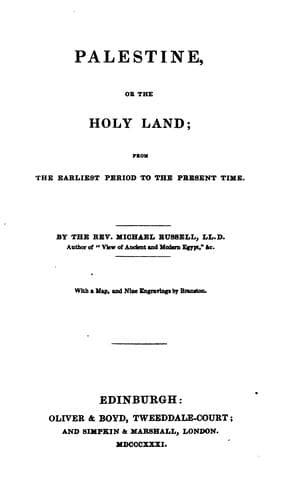
Palestine, or, the Holy Land: From the Earliest Period to the Present TimeRussell, Michael
History
Palestine, or, the Holy Land: From the Earliest Period to the Present Time
Russell, Michael
Palestine -- Description and travel; Palestine -- History
In the year six hundred and two before the Christian era, when Jehoiakim
was on the throne of Judah, Nebuchadnezzar, who already shared with his
father the government of Assyria, advanced into Palestine at the head of a
formidable army. A timely submission saved the city as well as the life of
the pusillanimous monarch. But after a short period, finding the conqueror
engaged in more important affairs, the vanquished king made an effort to
recover his dominions by throwing off the Babylonian yoke. The siege of
Jerusalem was renewed with greater vigour on the part of the invaders, in
the course of which Jehoiakim was killed, and his son Coniah ascended the
throne. Scarcely, however, had the new sovereign taken up the reigns of
government, when he found it necessary to open the gates of his capital to
the Assyrian prince, who carried him, his principal nobility, and the most
expert of his artisans, as prisoners to the banks of the Tigris.
The nominal authority was now confided to a brother or uncle of the
captive king, whose original name, Mattaniah, was changed to Zedekiah by
his lord paramount, who considered him merely as the governor of a
province. Impatient of an office so subordinate, and instigated, it is
probable, by the emissaries of Egypt, he resolved to hazard his life and
liberty for the chance of reconquering the independence of his crown. This
imprudent step brought Nebuchadnezzar once more before the walls of
Jerusalem. A siege, which appears to have continued fifteen or sixteen
months, terminated in the final reduction of the holy city, and in the
captivity of Zedekiah, who was treated with the utmost severity. His two
sons were executed in his presence, after which his eyes were put out;
when, being loaded with fetters, he was carried to Babylon and thrown into
prison.
The work of demolition was intrusted to Nebuzar-adan, the captain of the
guard, who "burnt the house of the Lord and the king's house, and all the
houses of Jerusalem, and every great man's house burnt he with fire. And
the army of the Chaldees that were with the captain of the guard brake
down the walls of Jerusalem round about. The rest of the people that were
left in the city, and the fugitives that fell away to the King of Babylon,
with the remnant of the multitude, did the captain of the guard carry
away. But he left the poor of the land to be vine-dressers and
husbandmen."[42]
The kings who reigned over Judah from the demise of Solomon to the
destruction of the first temple are as follows:--
Public-domain text, read in full here on John Shaqi.
Reviews
Reviews
No reviews yet
Be the first to share your thoughts on this work.
Elsewhere in the archive
Join the Discussion
Join the discussion
Sign in to leave a comment or review.
Sign InorCreate an account