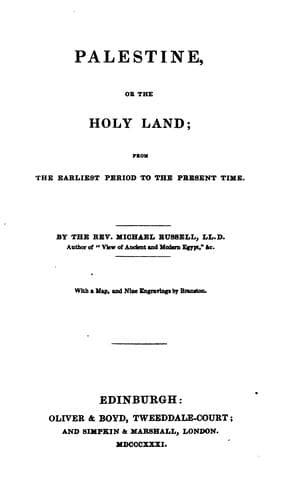
Palestine, or, the Holy Land: From the Earliest Period to the Present TimeRussell, Michael
History
Palestine, or, the Holy Land: From the Earliest Period to the Present Time
Russell, Michael
Palestine -- Description and travel; Palestine -- History
Years B.C.
1. Jeroboam 22 990
2. Nadad 2 968
3. Baasha 23 966
4. Ela 1 943
5. Zimri and Omri 11 942
6. Ahab 22 931
7. Ahaziah 2 909
8. Jehoram or Joram 12 907
9. Jehu 28 895
10. Jehoahaz 17 867
11: Jehoash or Joash 16 850
12. Jeroboam II 41 834
1st Interregnum 22 793
13. Zechariah and Shallum 1 771
14. Menahem 10 770
15. Pekahiah 2 760
16. Pekah 20 758
2d Interregnum 10 738
17. Hoshea 9 728
--- ---
Samaria taken 271 719
It appears to have escaped the notice of the greater number of
commentators, that the separation of interests, which in the days of
Rehoboam produced a permanent division of the tribes, had manifested
itself at a much earlier period. In truth, it is extremely doubtful
whether the union and co-operation between the northern and the southern
communities, which was meant to be accomplished by the institution of
monarchy, were ever cordial or efficient. There is no doubt, at least,
that the two parties differed essentially in their choice of a successor
to Saul; for, while the people of Judah invited David to the supreme power
as their annointed sovereign, the suffrages of Israel were unanimous in
favour of Ishbosheth, the son of the deceased king. We may therefore
conclude, that the exactions of Solomon were the pretext rather than the
true cause of the unfortunate dismemberment of the Hebrew confederation,
which in the end conducted both sections of it by gradual steps to defeat
and captivity.
The kingdom of Judah, less distracted by the pretensions of usurpers, and
being confirmed in the principles of patriotism by a more rigid adherance
to the law of Moses, continued during one hundred and thirty years to
resist the encroachments of the two rival powers, Egypt and Assyria, which
now began to contend in earnest for the possession of Palestine. Several
endeavours were made, even after the destruction of Samaria, to unite the
energies of the Twelve Tribes, and thereby to secure the independence of
the sacred territory a little longer. But a pitiful jealousy had succeeded
to the aversion generated by a long course of hostile aggression; while
the overwhelming hosts, which incessantly issued from the Euphrates and
the Nile to select a field of battle within the borders of Canaan, soon
left to the feeble councils of Jerusalem no other choice than that of an
Egyptian or an Assyrian master.
Public-domain text, read in full here on John Shaqi.
Reviews
Reviews
No reviews yet
Be the first to share your thoughts on this work.
Elsewhere in the archive
Join the Discussion
Join the discussion
Sign in to leave a comment or review.
Sign InorCreate an account