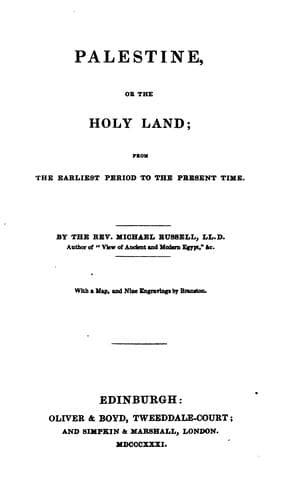
Palestine, or, the Holy Land: From the Earliest Period to the Present TimeRussell, Michael
History
Palestine, or, the Holy Land: From the Earliest Period to the Present Time
Russell, Michael
Palestine -- Description and travel; Palestine -- History
The tribes of Judah and Benjamin, who now constituted the whole Jewish
nation, brought back with them to Palestine the ancient spirit of
hostility towards the Israelitish kingdom, the people of which they were
pleased to class under the general denomination of Samaritans; an impure
race, descended from the eastern colonists sent by Shalmaneser to replace
the Hebrew captives whom he removed to Halah and Habor and the cities of
the Medes. In this way they roused an opposition, and created difficulties
which otherwise they might not have experienced during their erection of
the second Temple. The countenance of the Persian court itself was
occasionally withdrawn from men, who appeared to acknowledge no affinity
with any other order of human beings, and who seemed determined to exclude
from their country, as well as from their religious rites and privileges,
all who could not establish an immaculate descent from the father of the
faithful. For this reason, the sympathy which is so naturally excited in
the breast of the reader in behalf of the weary exiles, who sat down and
wept by the waters of Babylon with their thoughts fixed on Zion, is very
apt to be extinguished when he contemplates the bitter enmity with which
they rejected the kind offices of their ancient brethren amid the ruins of
their metropolis.
The names of Zerubbabel, Nehemiah, and Ezra occupy the most distinguished
place among those worthies who were selected by Divine Providence
to conduct the restoration of the chosen people. After much toil,
interruption, and alarm, Jerusalem could once more boast of a temple
which, although destitute of the rich ornaments lavished upon that of
Solomon; was at least of equal dimensions, and erected on the same
consecrated ground. But the worshipper had to deplore the absence of the
Ark, the symbolical Urim and Thummim, the Shechinah or Divine Presence,
and the celestial fire which had maintained an unceasing flame upon the
altar. Their Sacred Writings, too, had been dispersed, and their ancient
language was fast becoming obsolete. To prevent the extension of so great
an evil, the more valuable manuscripts were collected and arranged,
containing the Law, the earlier Prophets, and the inspired Hymns used for
the purpose of devotion. Some compositions, however, which respected the
remotest period of their commonwealth, especially the Book of Jasher and
the Wars of the Lord, were irretrievably lost.
Public-domain text, read in full here on John Shaqi.
Reviews
Reviews
No reviews yet
Be the first to share your thoughts on this work.
Elsewhere in the archive
Join the Discussion
Join the discussion
Sign in to leave a comment or review.
Sign InorCreate an account