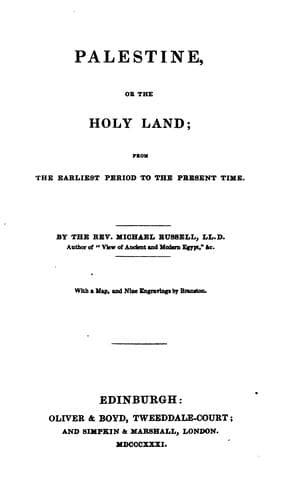
Palestine, or, the Holy Land: From the Earliest Period to the Present TimeRussell, Michael
History
Palestine, or, the Holy Land: From the Earliest Period to the Present Time
Russell, Michael
Palestine -- Description and travel; Palestine -- History
But the young princes required the sanction of the Roman emperor, whom
they both regarded as their liege lord; and with that view repaired to the
capital of Italy. The will of the late king was acknowledged and confirmed
by Augustus, who was moreover pleased to give to Herod Philip, their elder
brother, the provinces of Auranitis, Trachonitis, Paneas, and Batanea.
Achelaus, the metropolis of whose dominions was Jerusalem, ruled in
quality of ethnarch about nine years; but so little to the satisfaction
either of his master at Rome or of the people whom he was appointed to
govern, that at the end of this period he was summoned to render an
account of his administration at the imperial tribunal, when he was
deprived of his power and wealth, and finally banished into Gaul. Judea
was now reduced to a Roman province, dependent on the prefecture of Syria,
though usually place under the inspection of a subordinate officer, called
the procurator or governor. Thus the sceptre passed away from Judah, and
the lawgiver descended from the family of Jacob ceased to enjoy power
within the confines of the Promised Land.
No reader can require to be reminded, that it was at this epoch, in the
last year of the reign of Herod, the Messias was born, and conveyed into
Egypt for security. The unjust and cruel government of Archelaus, for
which, as has just been related, he was stripped of his authority by the
head of the empire, was probably the cause why the holy family did not
again take up their residence in Judea, but preferred the milder rule of
Antipas. When Joseph "heard that Archelaus did reign in Judea in the room
of his father Herod, he was afraid to go thither: notwithstanding, being
warned of God in a dream, he turned aside into the parts of Galilee: and
he came and dwelt in a city called Nazareth."[49]
The first thirty years of the Christian era did not pass away without
several insurrections on the part of the Jews, and repeated acts of
severity and extortion inflicted upon them by their stern conquerors.
The commotion excited by Judas, called the Gallilean, is regarded by
historians as one of the most important of those ebullitions which were
constantly breaking forth among that inflammatory people, not only on
account of its immediate consequences, but for the effects produced on
the national character, in regard to the speculative tenets connected
with tribute and submission to a heathen government.
Upon the exile of Archelaus, the prefecture of Syria was committed to
Publius Sulpicius Quirinius. This commander is mentioned in the Gospel of
St. Luke by the name of Cyrenius, and is described as the person under
whom the taxing was first made in that province. Hence we may conclude,
that the enrolment which took place at the birth of our Saviour was merely
a census, comprehending the numbers, and perhaps the wealth and station of
the several classes of the people.
Public-domain text, read in full here on John Shaqi.
Reviews
Reviews
No reviews yet
Be the first to share your thoughts on this work.
Elsewhere in the archive
Join the Discussion
Join the discussion
Sign in to leave a comment or review.
Sign InorCreate an account