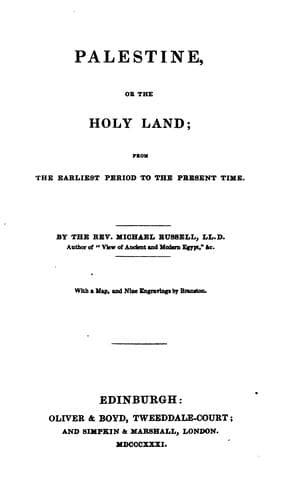
Palestine, or, the Holy Land: From the Earliest Period to the Present TimeRussell, Michael
History
Palestine, or, the Holy Land: From the Earliest Period to the Present Time
Russell, Michael
Palestine -- Description and travel; Palestine -- History
The death of Herod Philip and the degradation of the Galilean tetrarch
paved the way for the advancement of Agrippa to all the honour and power
which had belonged to the family of David. He was permitted to reign over
the whole of Palestine, having under his direction the usual number of
Roman troops, which experience had proved to be necessary for the peace of
a province at once so remote and so turbulent. The only event that
disturbed the tranquillity of his government was an insane resolution
expressed by Caligula to place his own statue in the temple of Jerusalem,
as an object of respect, if not of positive and direct worship to the
whole Jewish nation. The prudence of the Syrian prefect, and the influence
which Agrippa still possessed over the mind of his imperial friend,
prevented the horrors that must have arisen from the attempt to desecrate,
in this odious manner, a sanctuary deemed most holy by every descendant of
Abraham.
But no position could be more difficult to hold with safety and reputation
than that which was occupied by this Hebrew prince. He was assailed on the
one hand by the jealousy of the Roman deputies, and on the other by the
suspicion of his own countrymen, who could never divest themselves of the
fear that his foreign education had rendered him indifferent to the rites
of the Mosaical law. To satisfy the latter, he spared no expense in
conferring magnificence on the daily service of the temple, while he put
forth his hand to persecute the Christian church in the persons of St.
Peter and James the brother of John. To remove every ground of disloyalty
from the eyes of the political agents who were appointed by Claudius to
watch his conduct, he ordered a splendid festival at Cesarea in honour of
the new emperor; on which occasion, when arrayed in the moat gorgeous
attire, certain words of adulation reached his ear, not fit to be
addressed to a Jewish monarch. The result will be best described in the
words of sacred Scripture: "And upon a set day Herod, arrayed in royal
apparel, sat upon his throne, and made an oration unto them. And the
people gave a shout, saying, it is the voice of a god, and not of a man.
And immediately the angel of the Lord smote him, because he gave not God
the glory; and he was eaten of worms, and gave up the ghost."[50] He left
a son and three daughters, of whom Agrippa, Bernice, and Drusilla make a
conspicuous figure towards the close of the book of Acts. These events
took place between the fortieth and the forty-fifth years of the Christian
faith.
Public-domain text, read in full here on John Shaqi.
Reviews
Reviews
No reviews yet
Be the first to share your thoughts on this work.
Elsewhere in the archive
Join the Discussion
Join the discussion
Sign in to leave a comment or review.
Sign InorCreate an account