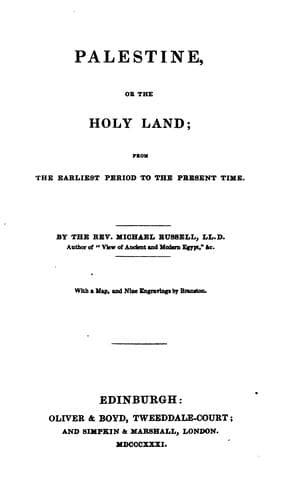
Palestine, or, the Holy Land: From the Earliest Period to the Present TimeRussell, Michael
History
Palestine, or, the Holy Land: From the Earliest Period to the Present Time
Russell, Michael
Palestine -- Description and travel; Palestine -- History
A succession of unprincipled governors, who were sent forth to enrich
themselves on the spoils of the Syrian provinces, accelerated the crisis
of Judea. About the middle of the first century the notorious Felix was
appointed to the government, who, in the administration of affairs,
habitually combined violence with fraud, sending out his soldiers to
inflict punishment on such as had not the means or the inclination to
bribe his clemency. An equal stranger to righteousness and temperance, he
presented a fine subject for the eloquence of St. Paul, who it is
presumed, however, made the profligate governor tremble, without either
affecting his religious principles or improving his moral conduct.
The short residence of Festus procured for the unhappy Jews a respite from
oppression. He laboured successfully to put down the bands of insurgents,
whose ravages were inflicted indiscriminately upon foreigners and their
own countrymen; nor was he less active in checking the excesses of the
military, so long accustomed to rapine and free quarter. Agrippa at the
same time transferred the seat of his government to Jerusalem, where his
presence served to moderate the rage of parties, and thereby to postpone
the final rupture between the provincials and their imperial master. But
this brief interval of repose was followed by an increased degree of
irritation and fury. Florus, alike distinguished for his avarice and
cruelty, and who saw in the contentions of the people the readiest means
for filling his own coffers, connived at the mutual hostility which it was
his duty to prevent. In this nefarious policy he received the countenance
of Cestius Gallus, the prefect of Syria, who, imitating the maxims of
his lieutenant, studiously drove the natives to insurrection, in order
that their cries for justice might be drowned amid the clash of arms.
But he forgot that there are limits to endurance even among the most
humble and abject. Unable to support the weight of his tyranny, and galled
by certain insults directed against their faith, the Jewish inhabitants of
Cesarea set his power at defiance, and declared their resolution to repel
his injuries by force. The capital was soon actuated by a similar spirit,
and made preparations for defence. Cestius marched to the gates, and
demanded an entrance for the imperial cohorts, whose aid was required to
support the garrison within. The citizens, refusing to comply; anticipated
the horrors of a siege, when after a few days they saw, to their great
surprise, the Syrian prefect in full retreat carrying with him his
formidable army. Sallying from the different outlets with arms in their
hands, they pursued the fugitives with the usual fury of an incensed
multitude; and, overtaking their enemy at the narrow pass of Bethhoron,
they avenged the cause of independence by a considerable slaughter of the
legionary soldiers, and by driving the remainder to an ignominious flight.
Public-domain text, read in full here on John Shaqi.
Reviews
Reviews
No reviews yet
Be the first to share your thoughts on this work.
Elsewhere in the archive
Join the Discussion
Join the discussion
Sign in to leave a comment or review.
Sign InorCreate an account