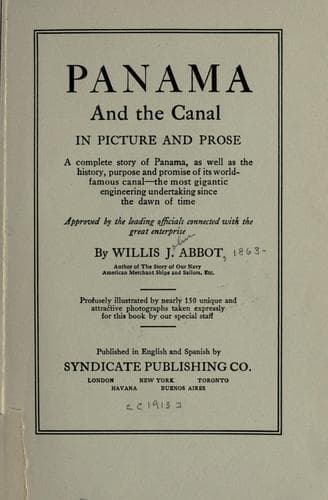
Panama and the Canal in Picture and ProseAbbot, Willis J. (Willis John)
History
Panama and the Canal in Picture and Prose
Abbot, Willis J. (Willis John)
Panama Canal (Panama) -- History
Sportsmen believe that this great artificial lake will in time become a
notable breeding place for fish and game. Many of our migratory northern
birds, including several varieties of ducks, now hibernate at the
Isthmus, and this broad expanse of placid water, with its innumerable
inlets penetrating a land densely covered with vegetation, should become
for them a favorite shelter. The population will be sparse, and mainly
as much as five miles away from the line of the canal through which the
great steamers will ceaselessly pass.
[Illustration: NATIVE STREET AT TABOGA]
During the period of its construction that portion of the canal which
will lie below the surface of Gatun Lake was plentifully sprinkled with
native villages, and held two or three considerable construction towns.
Of the latter Gorgona was the largest, which toward the end of canal
construction attained a population of about 4000. In the earlier history
of the Isthmus Gorgona was a noted stopping place for those crossing the
neck, but it seems to have been famed chiefly for the badness of its
accommodations. Otis says of it, “The town of Gorgona was noted in the
earlier days of the river travel as the place where the wet and jaded
traveler was accustomed to worry out the night on a rawhide, exposed to
the insects and the rain, and in the morning, if he was fortunate regale
himself on jerked beef and plantains.”
The French established railroad shops here which the Americans greatly
enlarged. As a result this town and the neighboring village of Matachin
became considerable centers of industry and Gorgona was one of the
pleasantest places of residence on “the line.” Its Y. M. C. A. clubhouse
was one of the largest and best equipped on the whole Zone, and the town
was well supplied with churches and schools. By the end of 1913 all this
will be changed. The shop will have been moved to the great new port of
Balboa; such of the houses and official buildings as could economically
be torn down and reërected will have been thus disposed of. Much of the
two towns will be covered by the lake, but on the higher portions of the
site will stand for some years deserted ruins which the all-conquering
jungle will finally take for its own. The railroad which once served its
active people will have been moved away to the other side of the canal
and Gorgona will have returned to the primitive wilderness whence
Pizarro and the gold hunters awakened it. Near its site is the hill
miscalled Balboa’s and from the steamships’ decks the wooden cross that
stands on its summit may be clearly seen.
[Illustration: _Photo by Underwood & Underwood_
GAMBOA BRIDGE WITH CHAGRES AT FLOOD
For contrasting picture showing the river in dry season, see page 192]
Public-domain text, read in full here on John Shaqi.
Reviews
Reviews
No reviews yet
Be the first to share your thoughts on this work.
Elsewhere in the archive
Join the Discussion
Join the discussion
Sign in to leave a comment or review.
Sign InorCreate an account