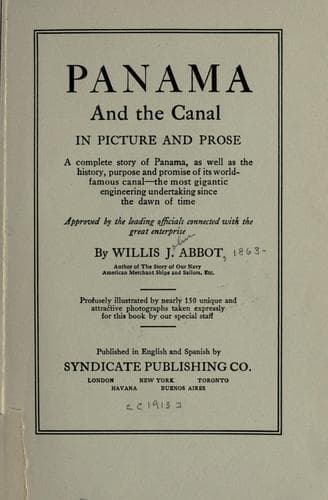
Panama and the Canal in Picture and ProseAbbot, Willis J. (Willis John)
History
Panama and the Canal in Picture and Prose
Abbot, Willis J. (Willis John)
Panama Canal (Panama) -- History
The tropical foliage grows swiftly, and long before the new waterway
will have become an accustomed path to the ships of all nations the
sloping banks will be thickly covered with vegetation. It is indeed the
purpose of the Commission to encourage the growth of such vegetation by
planting, in the belief that the roots will tie the soil together and
lessen the danger of slides and washouts. The hills that here tower
aloft on either side of the canal form part of the great continental
divide that, all the way from Alaska to the Straits of Magellan divides
the Pacific from the Atlantic watershed. This is its lowest point. Gold
Hill, its greatest eminence, rises 495 feet above the bottom of the
canal, which in turn is 40 feet above sea level. The story of the
gigantic task of cutting through this ridge, of the new problems which
arose in almost every week’s work, and of the ways in which they were
met and overcome will necessitate a chapter to itself. Those who float
swiftly along in well-appointed steamships through the almost straight
channel 300 feet wide at the bottom, between towering hills, will find
the sensation the more memorable if they will study somewhat the figures
showing the proportions of the work, the full fruition of which they are
enjoying.
[Illustration: _Photo by Underwood & Underwood_
MIRAFLORES LOCK IN MARCH, 1913
This lock is in two stories with a total lift of 56²⁄₃ feet; the Pacific
tides rise in the canal to the lower lock]
At Pedro Miguel a single lock lets the ship down to another little lake
hardly two miles across to Miraflores where two more locks drop it down
to tide water. From Miraflores the traveler can see the great bulk of
Ancon Hill looming up seven miles away, denoting the proximity of the
city of Panama which lies huddled under its Pacific front. Practically
one great rock is Ancon Hill, and its landward face is badly scarred by
the enormous quarry which the Commission has worked to furnish stone for
construction work. At its base is the new port of Balboa which is
destined to be in time a great distributing point for the Pacific coast
of both North and South America. For the vessels coming through the
canal from the Atlantic must, from Balboa, turn north or south or
proceed direct across the Pacific to those Asiatic markets of which the
old-time mariners so fondly dreamed. Fleets of smaller coastwise vessels
will gather here to take cargoes for the ports of Central America, or
for Ecuador, Colombia, Peru and other Pacific states of South America.
The Canal Commission is building great docks for the accommodation of
both through and local shipping; storage docks and pockets for coal and
tanks for oil. The coaling plant will have a capacity of about 100,000
tons, of which about one-half will be submerged. One dry dock will take
a ship 1000 feet long and 105 feet wide--the width of the dock itself
being 110 feet. There will be also a smaller dock. One pier, of the most
Public-domain text, read in full here on John Shaqi.
Reviews
Reviews
No reviews yet
Be the first to share your thoughts on this work.
Elsewhere in the archive
Join the Discussion
Join the discussion
Sign in to leave a comment or review.
Sign InorCreate an account