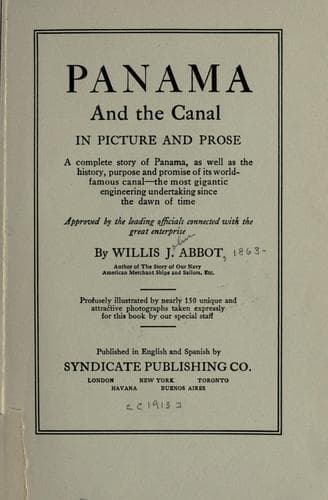
Panama and the Canal in Picture and ProseAbbot, Willis J. (Willis John)
History
Panama and the Canal in Picture and Prose
Abbot, Willis J. (Willis John)
Panama Canal (Panama) -- History
The feudal authority, the patriarchal power which Col. Goethals
possesses over the means of livelihood of every man on the Zone, nay
more, over their very right to stay on the Zone at all, gives to his
decisions more immediate effect than attends those of a court. The man
who incurs his displeasure may lose his job, be ousted from his lodgings
and deported from the Isthmus if the Colonel so decrees. A Jamaican
negress came in to complain that her husband took her earnings away from
her; would not work himself but lived and loafed on the fruits of her
industry. The Colonel ordered the man to allow her to keep her earnings.
The man demurred saying sullenly that the English law gave a husband
command over his wife’s wages.
[Illustration: A SIDE DRILL CREW AT WORK]
“All right,” said the Colonel, “you’re from Jamaica. I’ll deport you
both and you can get all the English law you want”.
The husband paid back the money he had confiscated and the pair stayed.
Family affairs are aired in the Colonel’s court to a degree which must
somewhat abash that simple and direct warrior. What the dramatists call
“the eternal triangle” is not unknown on the Zone, nor is the
unscriptural practice of coveting your neighbor’s wife wholly without
illustration. For such situations the Colonel’s remedy is specific and
swift--deportation of the one that makes the trouble. Sometimes the
deportation of two has been found essential, but while gossip of these
untoward incidents is plentiful in the social circles of Culebra and
Ancon the judge in the case takes no part in it.
It is not in me to write a character sketch of Col. Goethals. That is
rather a task for one who has known him intimately and has been able to
observe the earlier manifestations of those qualities that led President
Roosevelt to select him as the supreme chief of the canal work. All his
life he has been an army engineer, having a short respite from active
work in the field when he was professor of engineering at West Point.
Fortifications and locks were his specialties and fortifications and
locks have engaged his chief attention since he undertook the Panama
job. Perhaps it is due to his intensely military attitude that the
public has insensibly come to look upon the canal in its quality as an
aid to national defense rather than a stimulus to national commerce. For
the Colonel any discussion of the need for fortifying the canal was the
merest twaddle, and he had his way. He begged long for a standing army
of 25,000 men on the Zone, but it is doubtful whether he will win this
fight. Moreover he would so subordinate all considerations to the
military one that he urges the expulsion from the Zone of all save canal
employees that the danger of betrayal may be less. How far that policy
shall be approved by Congress is yet to be determined. Thus far however
the Colonel has handled Congress with notable success and even there his
dominant spirit may yet triumph.
[Illustration: THE COLONEL’S FIRE WORKS
Public-domain text, read in full here on John Shaqi.
Reviews
Reviews
No reviews yet
Be the first to share your thoughts on this work.
Elsewhere in the archive
Join the Discussion
Join the discussion
Sign in to leave a comment or review.
Sign InorCreate an account