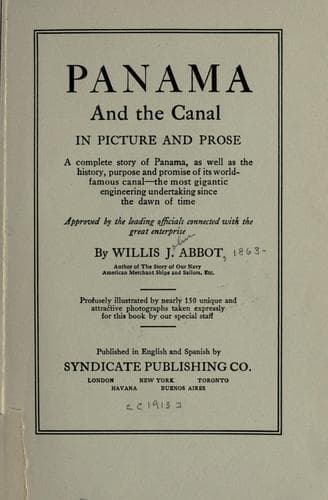
Panama and the Canal in Picture and ProseAbbot, Willis J. (Willis John)
History
Panama and the Canal in Picture and Prose
Abbot, Willis J. (Willis John)
Panama Canal (Panama) -- History
The spillway further serves a useful and an essential purpose in that it
harnesses the water power of the useful Chagres, and turns it into
electric power to open and shut the colossal gates of the various locks;
to propel the electric locomotives that tow the great ships through the
concrete channels; to light the canal towns and villages, and the
lighthouses on the line; to run the great cranes at Balboa and
Cristobal; to run the machinery in the shops at Balboa; to furnish
motive power, if so determined for the Panama Railroad, and to swing the
great guns at Toro Point and Naos Island until their muzzles bear with
calm yet frightful menace upon any enemy approaching from either the
Caribbean or the Pacific. There will be power for all these functions,
and power too to light Panama and Colon, to run the Panama tramway and
perform other useful functions if the present grip of private Panama
monopoly upon these public services shall be relinquished. The water
drops 75 feet through huge penstocks to great turbines in the spillway
hydro-electric station with a capacity of 6,000 kilowatts, but the
amount of water power is sufficient for double that current, and
turbines to supply the addition can be installed whenever the need for
the power develops.
[Illustration: THE WATER KNOCKING AT GATUN GATES]
[Illustration: WALL OF GATUN LOCK SHOWING ARCHED CONSTRUCTION]
The Gatun locks are built at the very eastern end of Gatun dam, at the
point where it joins the mainland bordering the Chagres valley. Of their
superficial dimensions I have already spoken, and have described their
appearance as seen from the deck of a ship in passage. It will be hard
however for one who has not stood on the concrete floor of one of these
massive chambers and looked upward to their crest, or walking out on one
of the massive gates peered down into their depths, to appreciate their
full size. It is all very well to say that the “Imperator,” the greatest
of ships now afloat, could find room in one of these locks with five
feet at each side, and fifty feet at each end to spare, but then few of
us have seen the Imperator and nobody has seen her in the lock. It is
all very well to figure that a six story house would not rise above the
coping of one of these locks, but imagination does not visualize the
house there, and moreover there are stories and stories in height. Yet
as one stood on the floor of one of these great monolithic tanks as they
were being rushed to completion in 1913, and saw locomotives dwarfed by
the ponderous walls betwixt which they plied, and whole trains of loaded
dump cars swallowed up in a single lock chamber, one got some idea of
the magnitude of the work. A track for a travelling crane extended down
the center of the chamber and the monster rumbled back and forth
carrying loads of material to their appointed destinations. Across the
whole width of the Canal below the locks stretched cable carriers upheld
Public-domain text, read in full here on John Shaqi.
Reviews
Reviews
No reviews yet
Be the first to share your thoughts on this work.
Elsewhere in the archive
Join the Discussion
Join the discussion
Sign in to leave a comment or review.
Sign InorCreate an account