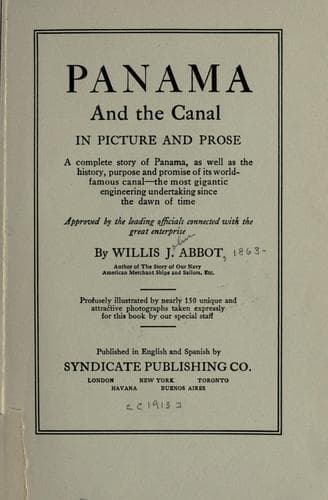
Panama and the Canal in Picture and ProseAbbot, Willis J. (Willis John)
History
Panama and the Canal in Picture and Prose
Abbot, Willis J. (Willis John)
Panama Canal (Panama) -- History
In a mild way the Chagres may lay claim to being a scenic stream, and
perhaps in future days when the excellence of its climate in the winter
becomes known in our United States, and the back waters of the lake have
made its upper reaches navigable, excursion launches may ply above
Cruces and almost to Alhajuela. Near the latter point is a spot which
should become a shrine for Progressive Republican pilgrims. A low cliff
of white limestone, swept clear of vegetation and polished by the river
at high water describes an arc of a circle hollowed out by the swift
river which rushes underneath. Springs on the bluff above have sent out
little rivulets which trickling down the face of the stone have scarred
it with parallel vertical grooves a foot or two apart. Seen from the
further side of the stream it bears a startling likeness to a huge human
upper jaw with glistening teeth. With a fine sense of the fitness of
things the river men have named it “Boca del Roosevelt”--Roosevelt’s
mouth.
[Illustration: A NATIVE CHARCOAL BURNER]
Some of the fluviograph stations are located far beyond the limits of
the Canal Zone, but by the terms of the treaty with the Republic of
Panama the Canal Commission has over such headwaters and reaches of the
Chagres such jurisdiction as may be necessary for the protection and
regulation of Gatun Lake. We went to one of these stations some 20 miles
of poling up the Chagres beyond Alhajuela. The keeper was a native of
the Canary Islands who had mastered English sufficiently to make his
reports over the ’phone. His wife, who greeted us in starched cotton
with a pink hair ribbon, pink shoes and a wealth of silver ornaments,
was a native, dark of complexion as a Jamaica negress, but her sister
who was there on a visit was as white as a Caucasian. Doctors on the
Zone say that these curious variations in type in the same family are so
common that they can never foretell within several shades, the
complexion of a baby about to be born.
The keeper of this station was paid $65.50 monthly and the Commission
supplied his house, which was of the native type and cost about $85.
Though many children, pickaninnies, little Canaries or whatever
clustered about his door, his living expenses were practically nothing.
Expense for clothing began only when the youngsters had reached 11 or 12
years of age and thereafter was almost negligible--as indeed were the
clothes. The river furnished fish, the jungle iguanas, wild pigs and
birds; the little garden patch yams, bananas, mangoes and other fruits.
He was far removed from the temptations of Matachin, or other riotous
market places and he saved practically all of his pay. His ambition was
to get enough to return to his native isles, buy a wine-shop and settle
down to a leisurely old age--though no occupation could much outdo for
laziness the task of watching for the rising of the Chagres in the dry
season.
[Illustration: THE NATIVES’ AFTERNOON TEA]
Public-domain text, read in full here on John Shaqi.
Reviews
Reviews
No reviews yet
Be the first to share your thoughts on this work.
Elsewhere in the archive
Join the Discussion
Join the discussion
Sign in to leave a comment or review.
Sign InorCreate an account