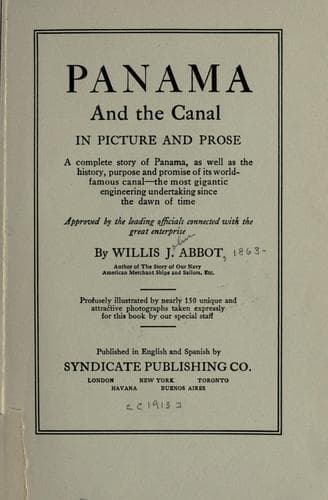
Panama and the Canal in Picture and ProseAbbot, Willis J. (Willis John)
History
Panama and the Canal in Picture and Prose
Abbot, Willis J. (Willis John)
Panama Canal (Panama) -- History
Technically what is known as the Culebra Cut extends from Bas Obispo to
the locks at Pedro Miguel, a distance of nine miles. To the general
public understanding, however, the term applies only to the point of
greatest excavation between Gold Hill and Contractor’s Hill. But at Bas
Obispo the walls of the Canal for the first time rise above the water
level of Gatun Lake. At that point the cutting begins, the walls rising
higher and higher, the Canal pressing stubbornly onward at a dead level,
until the supreme height of the continental divide is attained at Gold
Hill. Thenceforward on the line toward Panama City the hills grow lower
until at the entrance to the locks at Pedro Miguel the banks sink
practically to the water level. Out of this nine mile stretch there had
been taken up to January 1, 1913, just 88,531,237 cubic yards of
material and it was then estimated that there then remained to be
excavated 5,351,419 cubic yards more. But the later estimate was
destined to be largely increased for, after the date at which it was
made, the number and extent of “slides” in the deepest part of the cut
increased to staggering proportions. Col. D. D. Gaillard, Member of the
Commission and Division Engineer in charge of the Culebra Cut, estimated
in 1912 that in all 115,000,000 cubic yards would have to be removed.
To the general public the slides seemed to menace the very existence and
practicability of the Canal, though the engineers knew that they began
even with the superficial excavating done by the French, and had
therefore made allowance for them in their estimates. Not sufficient
allowance however was made, and as month after month brought tidings of
new slides, with terrifying details of such incidents as whole forests
moving, vast cracks opening in the earth, large buildings in imminent
danger of being swept into the Cut, the bottom of the Canal mysteriously
rising ten to fifteen feet in the air, while smoke oozed from the pores
of the adjacent earth--when such direful reports filled the newspapers
the public became nervous, almost abandoning hope of the success of the
great enterprise.
[Illustration: WORKING ON THREE LEVELS]
This attitude of apprehension on the part of the public is scarcely
surprising. If the Capitol Park at Washington, with the National Capitol
cresting it, should suddenly begin to move down into Pennsylvania Avenue
at the rate of about three feet a day the authorities of the city would
naturally feel some degree of annoyance. And if the smooth and level
asphalt of that historic thoroughfare should, over night, rise up into
the air 18 feet in spots those responsible for traffic might not
unreasonably be somewhat worried.
Public-domain text, read in full here on John Shaqi.
Reviews
Reviews
No reviews yet
Be the first to share your thoughts on this work.
Elsewhere in the archive
Join the Discussion
Join the discussion
Sign in to leave a comment or review.
Sign InorCreate an account