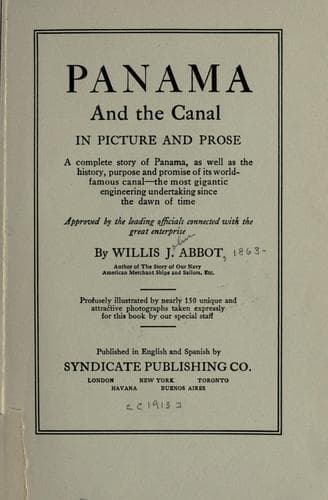
Panama and the Canal in Picture and ProseAbbot, Willis J. (Willis John)
History
Panama and the Canal in Picture and Prose
Abbot, Willis J. (Willis John)
Panama Canal (Panama) -- History
To us as we plod along all seems to be conducted with terrific energy,
but without any recognizable plan. As a matter of fact all is being
directed in accordance with an iron-clad system. That train, the last
cars of which are being loaded, on the second level must be out of the
Cut and on the main line at a fixed hour or there will be a tie-up of
the empties coming back from the distant dumps. That row of holes must
be drilled by five o’clock, for the blast must be fired as soon as the
Cut is emptied of workers. The very tourists on the observation car
going through the Cut must be chary of their questions, for that track
is needed now for a train of material. If they are puzzled by something
they see, it will all be explained to them later by the guide in his
lecture illustrated by the working model at the Tivoli Hotel.
[Illustration: THE ROCK-BREAK THAT ADMITTED THE BAS OBISPO]
So trudging through the Cut we pass under a slender foot bridge
suspended across the Canal from towers of steel framework. The bridge
was erected by the French and will have to come down when the procession
of ships begins the passage of the Canal. Originally its towers were of
wood, but a man idly ascending one thought it sounded hollow beneath his
tread and, on examination, found the interior had been hollowed out by
termite ants leaving a mere shell which might give way under any
unaccustomed strain. This is a pleasant habit of these insects and
sometimes produces rather ludicrous results when a heavy individual
encounters a chair that has engaged their attention.
[Illustration: _Photo by H. Pittier. Courtesy National Geographic
Magazine_
AN ANT’S NEST ON THE SAVANNA]
The activity and industry of the ant are of course proverbial in every
clime, but it seems to me that in the Isthmus particularly he appears to
put the sluggard to shame. As you make your way through the jungle you
will now and again come upon miniature roads, only about four inches
wide it is true, but vastly smoother and better cleaned of vegetation
than the paths which the Panamanians dignify with the name of roads.
Along these highways trudges an endless army of ants, those going
homeward bearing burdens of leaves which, when buried in their
subterranean homes, produce fungi on which the insects live. Out on the
savanna you will occasionally find a curious mound of hard dirt,
sometimes standing taller than a man and rising abruptly from the plain.
It is an ant’s nest built about a shrub or small tree, which usually
dies off so that no branches protrude in any direction. A large one
represents long years of the work of the tiny insects. Col. Goethals has
made a great working machine of the Canal organization but he can teach
the ants nothing so far as patient and continuous industry is concerned.
[Illustration: A TERMITE ANT’S NEST
The ants’ work kills the tree]
Public-domain text, read in full here on John Shaqi.
Reviews
Reviews
No reviews yet
Be the first to share your thoughts on this work.
Elsewhere in the archive
Join the Discussion
Join the discussion
Sign in to leave a comment or review.
Sign InorCreate an account