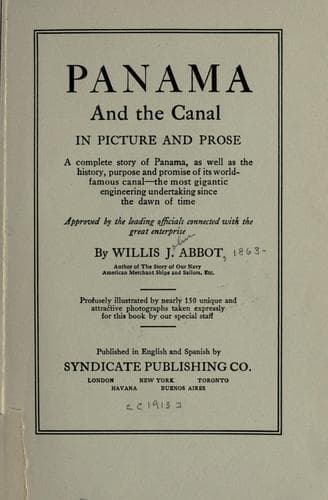
Panama and the Canal in Picture and ProseAbbot, Willis J. (Willis John)
History
Panama and the Canal in Picture and Prose
Abbot, Willis J. (Willis John)
Panama Canal (Panama) -- History
The entrance by railway to Panama is not prepossessing, but for that
matter I know of few cities in which it is. Rome and Genoa perhaps excel
in offering a fine front to the visitor. But in Panama when you emerge
from the station after a journey clear across the continent, which has
taken you about three hours, you are confronted by a sort of ragged
triangular plaza. In the distance on a hill to your right is set the
Tivoli Hotel looking cool and inviting with its broad piazzas and dress
of green and white. To your left is a new native hotel, the
International, as different from the Tivoli as imaginable, built of
rubble masonry covered with concrete stucco, with rooms twice as high as
those of the usual American building. It looks cool too, in a way, and
its most striking feature is a pleasingly commodious bar, with wide open
unscreened doors on the level of the sidewalk. The Tivoli Hotel, being
owned and managed by the United States government, has no bar. This
statement is made in no spirit of invidious comparison, but merely as a
matter of helpful information to the arriving traveler undecided which
hotel to choose.
[Illustration: _Photo by Underwood & Underwood_
PANAMA FROM THE SEA WALL; CATHEDRAL TOWERS IN DISTANCE]
The plaza is filled with Panama cabs--small open victorias, drawn by
stunted wiry horses like our cow ponies and driven by Panama negroes who
either do not speak English, or, in many cases, pretend not to in order
to save themselves the trouble of explaining any of the sights to their
fares. There is none of the bustle that attends the arrival of a train
in an American city. No raucous cries of “Keb, sir? Keb”! no
ingratiating eagerness to seize upon your baggage, no ready proffer of
willingness to take you anywhere. If the Panama cabby shows any interest
at all in getting a fare out of an arriving crowd it seems to be in
evading the one who beckons him, and trying to capture someone else. One
reason perhaps for the lethargy of these sable jehus is that the
government has robbed their calling of its sporting feature by fixing
their fare at ten cents to any place in town. Opportunity to rob a fare
is almost wholly denied them, hence their dejected air as compared with
the alert piratical demeanor of the buccaneers who kidnap passengers at
the railway stations of our own enlightened land. The only way the
Panama driver can get the best of the passenger is by construing each
stop as the end of a trip, and the order to drive on as constituting a
new engagement involving an additional dime. Tourists who jovially drew
up to the curbstone to greet acquaintances met _en route_ several times
in a half-hour’s ride are said to have been mulcted of a surprising
number of dimes, but in justice to the Panama hackman--who really
doesn’t have the air of rioting in ill-gotten wealth--I must say that I
never encountered an instance of this overcharge.
Public-domain text, read in full here on John Shaqi.
Reviews
Reviews
No reviews yet
Be the first to share your thoughts on this work.
Elsewhere in the archive
Join the Discussion
Join the discussion
Sign in to leave a comment or review.
Sign InorCreate an account