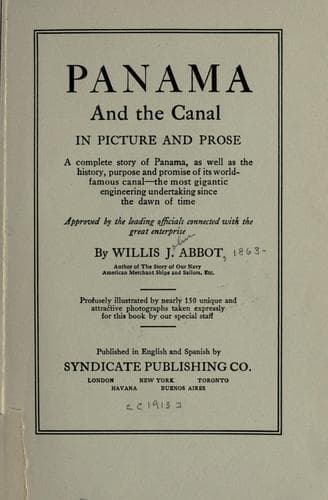
Panama and the Canal in Picture and ProseAbbot, Willis J. (Willis John)
History
Panama and the Canal in Picture and Prose
Abbot, Willis J. (Willis John)
Panama Canal (Panama) -- History
The original city stood on a peninsula, and three sides of this were
bounded by the sea wall, rising from about high water mark to a height
of from twenty to thirty feet. About half way between the present plazas
of the Cathedral and Santa Ana the wall turned inward with a great
frowning bastion at each corner and crossed the Isthmus. A moat was dug
on its landward side, shutting off all communication with the mainland
save over the drawbridge and through the sally-port on the line of the
Avenida Centrale. With drawbridge up and sally-port closed the old town
was effectually shut off from attack by land, while its guns on the
landward wall effectually commanded the broad plain on which now stands
the upper part of the town, and the declivities of Ancon Hill where now
are the buildings of the Zone hospital and the Tivoli Hotel.
[Illustration: VAULTS IN THE PANAMA CEMETERY
The small sepulchres are rented for a specified time, usually three
years. Unless the lease is then renewed the bones of the tenant are cast
out into a common pile.]
A good bit of construction and of military engineering was the wall of
Panama--our own engineers on the Canal have done no better. Round the
corner from La Mercedes Church a salient bastion crops out among fragile
frame tenements and jerry-built structures. The angle is as sharp as
though the storms of two and a half centuries had not broken over it.
Climb it and you will find the top level, grassy, and broad enough for a
tennis court full thirty feet above the level of the town. The
construction was not unlike that of the center walls of the locks
designed by the best American engineers. Two parallel walls of masonry
were built, about forty to fifty feet apart and the space between filled
in with dirt, packed solidly. On this part of the wall were no bomb
proofs, chambers or dungeons. The guns were mounted _en barbette_, on
the very top of the wall and discharged through embrasures in the
parapet. Rather let it be said that they were to have been fired, for
the new Panama was built after the plague of the pirates had passed and
the bane of the buccaneers was abated. No foe ever assaulted the city
from its landward side. In the frequent revolutions the contending
parties were already within the town and did their fighting in its
streets, the old walls serving no more useful purpose than the ropes
which define a prize ring. Only the sea-wall has heard the thunder of
cannon in deadly conflict. There during the brief revolution which gave
the United States the whip hand in Panama a Colombian gunboat did indeed
make a pretense of shelling the city, but was driven away by machine
guns mounted on the wall.
[Illustration: RUINS OF SAN DOMINGO CHURCH]
Public-domain text, read in full here on John Shaqi.
Reviews
Reviews
No reviews yet
Be the first to share your thoughts on this work.
Elsewhere in the archive
Join the Discussion
Join the discussion
Sign in to leave a comment or review.
Sign InorCreate an account