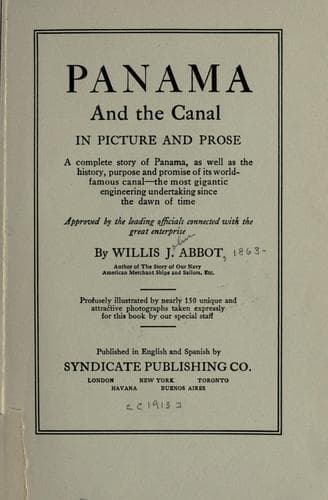
Panama and the Canal in Picture and ProseAbbot, Willis J. (Willis John)
History
Panama and the Canal in Picture and Prose
Abbot, Willis J. (Willis John)
Panama Canal (Panama) -- History
Avenida Centrale ends its arterial course at the sea wall of the city,
or at least at that part of the sea wall which is the best preserved and
retains most of its old-time dignity. It is here something like the
Battery at Charleston, S. C., though the houses fringing it are not of a
like stateliness, and the aristocracy of the quarter is somewhat
tempered by the fact that here, too, is the city prison. Into the
courtyards of this calaboose you can gaze from sundry little sentry
boxes, the little sentries in which seem ever ready to step out to let
the tourist step in and afterward pose for his camera, with rifle, fixed
bayonet and an even more fixed expression. The greater part of one of
the prison yards is given over to flower beds, and though sunken some
twenty feet or more below the crest of the wall, is thoughtfully
provided with such half-way stations in the way of lean-to sheds,
ladders and water butts that there seems to be no reason why any
prisoner should stay in who wants to get out. But perhaps they don’t
often yearn for liberty. A wire fence cuts off the woman’s section of
the jail and the several native women I observed flirting assiduously
with desperate male malefactors from whom they were separated only by
this fence, seemed content with their lot, and evidently helped to
cultivate like resignation in the breasts of their dark adorers. A
white-clad guard, machete at side and heavy pistol at belt, walks among
them jingling a heavy bunch of keys authoritatively but offering no
interruption to their tender interludes.
On the other side of the row of frame quarters by which the prison yard
is bisected you can see at the normal hours the prisoners taking their
meals at a long table in the open air. Over the parapet of the sea wall
above, an equally long row of tourists is generally leveling cameras,
and sometimes exchanging lively badinage with some criminal who objects
to figuring in this amateur rogues’ gallery. To the casual spectator it
all savors of opera bouffe, but there are stories a-plenty that the
Panama jail has had its share of brutal cruelty as have most places
wherein men are locked away from sight and subject to the whims of
others not so very much their superiors. Once the Chiriqui Prison was a
fortress, the bank of quarters for the prisoners formed the barracks,
and the deep archways under the sea wall were dungeons oft populated by
political prisoners. Miasma, damp and the brutality of jailers have many
a time brought to occupants of those dungeons their final discharge, and
a patch of wall near by, with the bricks significantly chipped, is
pointed out as the place where others have been from time to time stood
up in front of a firing squad at too short a range for misses. The
Latin-American lust for blood has had its manifestations in Panama, and
the old prison has doubtless housed its share of martyrs.
[Illustration: THE FLOWERY CHIRIQUI PRISON
Public-domain text, read in full here on John Shaqi.
Reviews
Reviews
No reviews yet
Be the first to share your thoughts on this work.
Elsewhere in the archive
Join the Discussion
Join the discussion
Sign in to leave a comment or review.
Sign InorCreate an account