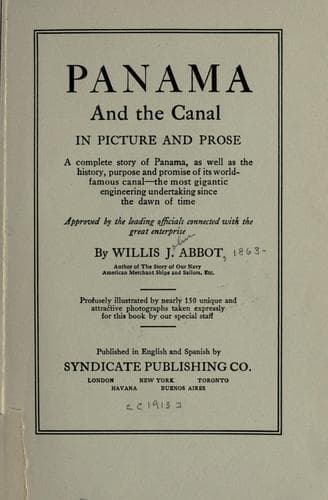
Panama and the Canal in Picture and ProseAbbot, Willis J. (Willis John)
History
Panama and the Canal in Picture and Prose
Abbot, Willis J. (Willis John)
Panama Canal (Panama) -- History
Col. Gorgas first visited the Isthmus in 1904. In a little pamphlet
which I have before me he then described simply the essence of the
problem he had to meet. He found camped on a hill, perfectly drained and
supplied with good water, 450 marines--who of course were men of
exceptionally good physique, robust and vigorous. Yet in four months 170
out of the 450 were infected with malaria, and Col. Gorgas said, “if
these men were our laborers, working daily in Culebra Cut, exposed to
the sun and weather, many of these cases would be severe in type and at
the end of the year we would be approaching the mortality of the
French”. The cause for the infection was apparent. Though the marines’
camp was clean and sanitary there was at the foot of the hill, on which
it was perched, a village of 400 or 500 Jamaica negroes. Examination of
the people showed that all suffered from chronic malaria. The marine
strolling in the village would be bitten by a mosquito--the _anopheles_
which is partial to malaria--which had already bitten an infected negro.
The result was the spread of the infection among the marines. As Col.
Gorgas put it, “The condition is very much the same as if these four or
five hundred natives had the smallpox and our marines had never been
vaccinated”. To correct this condition he proposed, “to take this
village, put it under a systematic scheme of inspection, whereby we will
be able to control all water barrels and deposits of water, so that no
mosquitoes will be allowed to breed, look after its street cleaning and
disposal of night soil, etc., so as to get it in good sanitary
condition, then have the population examined and recorded, so that we
will have on a card a short history of each individual and keep track of
them in this way. Those suffering from malaria will be put under
treatment, and watched as long as the malarial parasite is found in the
blood. I hope, in this way, to decrease to the smallest limit the
number of _anopheles_, the malarial-bearing mosquito, and, at the same
time, to gradually eliminate the human being as a source of infection,
so that at the end of a year it will be entirely safe for an
unacclimated man to live in this village”.
[Illustration: THE WAR ON MOSQUITOES. I.
The men are oiling the surface of the streams to kill the larvae]
[Illustration: THE WAR ON MOSQUITOES. II.
Burning the grass that affords cover]
Public-domain text, read in full here on John Shaqi.
Reviews
Reviews
No reviews yet
Be the first to share your thoughts on this work.
Elsewhere in the archive
Join the Discussion
Join the discussion
Sign in to leave a comment or review.
Sign InorCreate an account