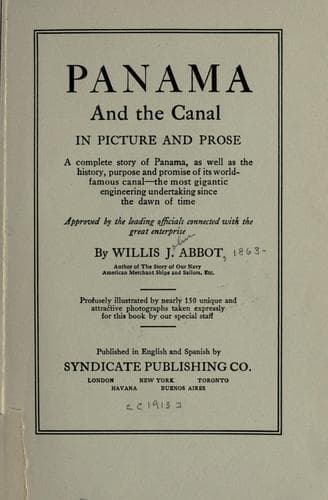
Panama and the Canal in Picture and ProseAbbot, Willis J. (Willis John)
History
Panama and the Canal in Picture and Prose
Abbot, Willis J. (Willis John)
Panama Canal (Panama) -- History
The fight then against disease on the Isthmus resolved itself largely
into a war of extermination upon the two noxious varieties of
mosquitoes. It involved first a cleaning up, paving and draining of the
two towns. Curiously enough bad smells are not necessarily unhygienic,
but they betoken the existence of matter that breeds disease germs, and
flies and other insects distribute those germs where they will do the
most harm. Colon and Panama therefore were paved and provided with
sewage systems, while somewhat stringent ordinances checked the pleasant
Panama practice of emptying all slops from the front gallery into the
street. It is fair to the Panamanians to note that in the end they will
pay for the vigorous cleaning and refurbishing of their towns by the
Americans. Our sanitary forces did the work and did it well, by virtue
of the clause in the treaty which grants the United States authority to
prosecute such work in the two cities and collect from the householder
its cost by means of water and sewage rates.
[Illustration: _Photo by Underwood & Underwood_
SANITARY WORK IN A VILLAGE
The scene is in the outskirts of Culebra, now a model of cleanliness]
This work was completed in 1908 and the final report of the Division of
Municipal Engineering which conducted it showed that nearly $6,000,000
had been expended, of which about $2,250,000 was for pavements, sewers
and waterworks in the two cities, and about $3,500,000 for work in the
Canal Zone. Nearly a million more was subsequently expended in the
towns.
The first thing to do with the towns was to fumigate them. The
Panamanians did not like this. Neither would we or any other people for
that matter, for the process of fumigating necessarily interrupts the
routine of life, invades domestic privacy, inevitably causes some loss
by the discoloring of fabrics, interrupts trade in the case of stores
and is in general an infernal nuisance. That much any people will say
against wholesale fumigation. But to the Panamanians it was peculiarly
offensive because they were immune from yellow fever anyway, and to some
extent from malaria as well, so to their minds the whole thing was an
imposition by which the Americans alone would profit. If the gringoes
weren’t able to live in Panama without smoking people out of house and
home, they had better stay away was the generally expressed public
opinion of Panama.
Public-domain text, read in full here on John Shaqi.
Reviews
Reviews
No reviews yet
Be the first to share your thoughts on this work.
Elsewhere in the archive
Join the Discussion
Join the discussion
Sign in to leave a comment or review.
Sign InorCreate an account