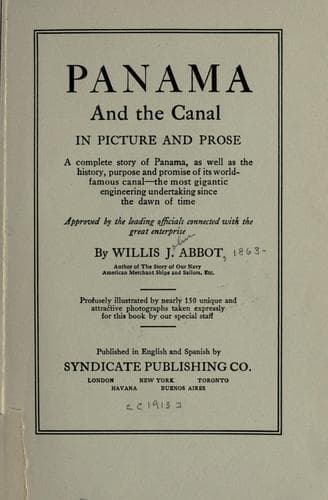
Panama and the Canal in Picture and ProseAbbot, Willis J. (Willis John)
History
Panama and the Canal in Picture and Prose
Abbot, Willis J. (Willis John)
Panama Canal (Panama) -- History
The annual vacations of the workers during the construction period may
properly be considered in connection with sanitation work on the Zone,
for they were not permitted to be mere loafing time. The man who took a
vacation was not allowed to stay on the Isthmus. If he tried to stay
there Col. Goethals found it out in that omniscient fashion of his and
it was a case of hike for a change of air or go back to work. For,
notwithstanding the fact that Col. Gorgas pulled the teeth of the
tropics with his sanitary devices and regulations, an uninterrupted
residence in that climate does break down the stamina and enfeeble the
energy of men from more temperate climes. Every employee was given 42
days’ vacation with full pay, but he had to quit the Zone for some
country which would afford a beneficial climatic change. Of course most
went back to the United States, being encouraged thereto by a special
rate on the steamship of $30--the regular rate being $75. But beside
this vacation each employee was entitled to 30 days’ sick leave. It was
not an exceedingly difficult task to conjure up enough symptoms to
persuade a friendly physician to issue a sick order. The favorite method
of enjoying this respite from work was to spend as little of the time as
possible at Ancon, and the rest at the sanitarium on the Island of
Taboga.
[Illustration: TABOGA IS FURTHERMORE THE CONEY ISLAND OF PANAMA]
That garden spot in the Bay of Panama where the French left the
sanitarium building we now use is worth a brief description. You go
thither in a small steamboat from Balboa or Panama and after about three
hours’ steaming a flock of little white boats, each with a single
oarsman, puts out from the shore to meet you like a flock of gulls as
you drop anchor in a bay of truly Mediterranean hue. To the traveled
visitor the scene is irresistibly reminiscent of some little port of
Southern Italy, and the reminder is all the more vivid when one gets
ashore and finds the narrow ways betwixt the elbowing houses quite
Neapolitan for dirt and ill odor. But from the sea one looks upon a
towering hill, bare toward its summit, closely covered lower down by
mango, wild fig, and ceiba trees, bordered just above the red roofs of
the little town by a fringe of the graceful cocoanut palms. Then come
the houses, row below row, until they descend to the curving beach
where the fishing boats are drawn up out of reach of the tide which
rises some 20 feet.
Public-domain text, read in full here on John Shaqi.
Reviews
Reviews
No reviews yet
Be the first to share your thoughts on this work.
Elsewhere in the archive
Join the Discussion
Join the discussion
Sign in to leave a comment or review.
Sign InorCreate an account