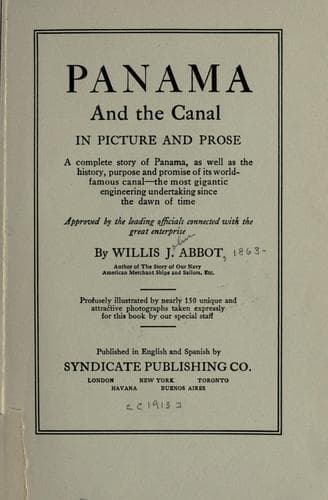
Panama and the Canal in Picture and ProseAbbot, Willis J. (Willis John)
History
Panama and the Canal in Picture and Prose
Abbot, Willis J. (Willis John)
Panama Canal (Panama) -- History
But within it shows signs of a reverent affection by its flock not
common in Latin-American churches. We may laugh a little at the altar
decorations which are certainly not costly and may be a little tawdry,
but they show evidences of patient work on the part of the women, and
contributions by the men from the slender gains permitted them by the
harsh land and the reluctant sea. About the walls hang memorial tablets,
not richly sculptured indeed, but showing a pious desire on the part of
bygone generations to have the virtue of their loved ones commemorated
within hallowed walls. Standing in a side aisle was an effigy of Christ,
of human size, bearing the cross up the hill of Gethsemane. The figure
stood on a sort of platform, surrounded by six quaint lanterns of panes
of glass set in leaded frames of a design seen in the street lamps of
the earlier Spanish cities. The platform was on poles for bearers, after
the fashion of a sedan chair, and we learned from one who, more
fortunate than we, had been there to see, that in Holy Week there is a
sort of Passion Play--rude and elementary it is true, but bringing to
the surface all the religious emotionalism of the simple people. The
village is crowded with the faithful from afar, who make light of any
lack of shelter in that kindly tropic air. The Taboga young men dress as
Roman soldiers, the village maidens take their parts in the simple
pageant. The floats, such as the one we saw, are borne up and down the
village streets which no horse could ever tread, and the church is
crowded with devotional worshipers until Easter comes with the joyous
tidings of the Resurrection.
[Illustration: THE CHIEF INDUSTRY OF THE NATIVES IS FISHING]
[Illustration: NURSES’ QUARTERS AT ANCON]
As to the part of Taboga in the economy of the Canal work, we have there
a sanitarium inherited from the French, and used as a place of
convalescence for almost recovered patients from the hospitals of the
Zone. After breathing the clear, soft air, glancing at the comfortable
quarters and enjoying to the fullest a lunch costing fifty cents that
would put Broadway’s best to the test, and make the expensive Tivoli
dining-room seem unappetizing in comparison, we could well understand
why every employee with thirty days’ sick leave to his credit gets just
such a slight ailment as needs a rest at Taboga for its cure.
Public-domain text, read in full here on John Shaqi.
Reviews
Reviews
No reviews yet
Be the first to share your thoughts on this work.
Elsewhere in the archive
Join the Discussion
Join the discussion
Sign in to leave a comment or review.
Sign InorCreate an account