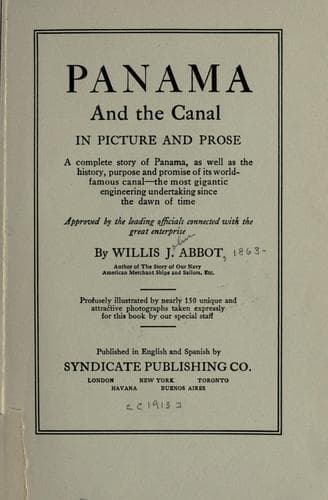
Panama and the Canal in Picture and ProseAbbot, Willis J. (Willis John)
History
Panama and the Canal in Picture and Prose
Abbot, Willis J. (Willis John)
Panama Canal (Panama) -- History
The Bayano River region beside being the center of such lumbering
activities as the Zone knows at present is the section in which are
found the curious vegetable ivory nuts which, though growing wild, have
become one of the principal products of Panama. Only a few years ago
they were looked upon merely as curiosities but are now a useful new
material. They are gathered by the natives and sold to dealers in
Panama who ship them north to be made into buttons and other articles
of general use. Nobody has yet experimented with the cultivation of the
tree, and there is reason to believe that with cultivation larger nuts
could be obtained, and, by planting, considerable groves established.
The trees grow well in every part of the Darien, and the demand, with
the rapid diminution in the supply of real ivory, should be a growing
one.
Indeed, the more one studies Panama and its resources the more one is
convinced that all that is necessary to make the country a rich and
prosperous one, or at any rate to cause it to create riches and
prosperity for investors, is the application of capital, labor and
systematic management to the resources it already possesses. In its 400
years of Spanish and mestizo control these three factors have been
continuously lacking. There are men in Panama, of native birth and of
Spanish origin, who have undertaken to develop certain of the land’s
resources and have moderately enriched themselves. But the most striking
evidence of the success to be obtained from attacking the industrial
problem in Panama systematically and in a big way is that furnished by
the operations of the United Fruit Company, the biggest business fact in
the tropics.
Panama is, of course, only one link in the colossal chain of the
operations of this company in the tropics. The rapidly increasing
prosperity of many of the Central Republics is due largely to the
sweeping scope of the United Fruit Company, and its impress is in
evidence all along the north coast of South America and throughout the
West Indies. Its interests in Jamaica are enormous. Cuba put Jamaica off
the sugar map, but the United Fruit Company came to her rescue with an
offer to purchase all the bananas her planters could furnish, and
Jamaica now leads the American tropics with 17,000,000 bunches annually,
of which the United Fruit Company obtains nearly half, the balance being
handled by its competitors. The company also owns the famous Titchfield
Hotel of Port Antonio, and operates the Myrtle Bank Hotel of Kingston.
In Cuba the company owns 60,000 acres of sugar plantations and its two
great sugar mills will this year add to the world’s product an amount
with a market value in excess of $10,000,000. Its scores of white
steamships, amazingly well contrived and fitted for tropical service,
constitute one of the pleasantest features of travel on these sunlit
seas.
[Illustration: IN THE BANANA COUNTRY]
[Illustration: MARKET PLACE AT ANCON]
[Illustration: FRUIT COMPANY STEAMER AT WHARF]
Public-domain text, read in full here on John Shaqi.
Reviews
Reviews
No reviews yet
Be the first to share your thoughts on this work.
Elsewhere in the archive
Join the Discussion
Join the discussion
Sign in to leave a comment or review.
Sign InorCreate an account