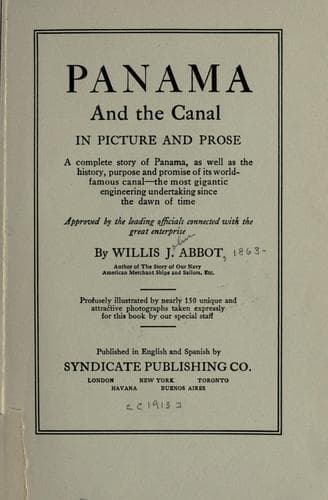
Panama and the Canal in Picture and ProseAbbot, Willis J. (Willis John)
History
Panama and the Canal in Picture and Prose
Abbot, Willis J. (Willis John)
Panama Canal (Panama) -- History
Westward from David the face of the country rises gently until you come
to the Caldera Valley which lies at the foot of the Chiriqui Peak, an
extinct volcano perhaps 8000 feet high. Nowhere in Panama do the
mountains rise very high, though the range is clearly a connection of
the Cordilleras of North and South America. The Chiriqui Peak has not in
the memory of man been in eruption, but the traces of its volcanic
character are unmistakable. Its crater is a circular plain about half a
mile in diameter surrounded by a densely wooded precipitous ridge. As
the ascent is continued the woods give way to grass and rocks. While
there is a distinct timber line, no snow line is attained. At the foot
of the mountain is El Bouquette, much esteemed by the Panamanians as a
health resort. Thither go Canal workers who, not being permitted to
remain on the Zone during their vacations, wish to avoid the long voyage
to North American ports.
[Illustration: CHIRIQUI NATIVES IN AN OX-CART]
This neighborhood is the center of the coffee-growing industry which
should be profitable in Panama if a heavy protective tariff could make
it so. But not even enough of the fragrant berries are grown to supply
home needs, and the industry is as yet largely prosecuted in an
unsystematic and haphazard manner. It is claimed that sample shipments
of coffee brought high prices in New York, but as yet not enough is
grown to permit exportation. Cacao, which thrives, is grown chiefly by
English and German planters, but as yet in a small way only. Cotton,
tobacco and fiber plants also grow readily in this region but are little
cultivated.
[Illustration: PROCLAIMING A LAW AT DAVID
There being a dearth of newspapers and readers, new laws are promulgated
by being read aloud]
A curious industry of the Chiriqui country, now nearly abandoned, was
the collection of gold ornaments which the Guaymi Indians formerly
buried with their dead. These images sometimes in human form, more often
in that of a fish, sometimes like frogs and alligators, jointed and
flexible, were at one time found in great quantities and formed a
conspicuous feature of the Panama curiosity shops. In seeking these the
hunters walked back and forth over the grounds known to be Indian burial
places, tapping the ground with rods. When the earth gave forth a hollow
sound the spade was resorted to, and usually a grave was uncovered. Jars
which had contained wine and food were usually found in the graves,
which were in fact subterranean tombs carefully built with flat stones.
The diggers tell of finding skulls perfectly preserved apparently but
which crumbled to pieces at a touch. Evidently the burial places which
can be identified through local tradition have been nearly exhausted,
for the ancient trinkets cannot longer be readily found in the Panama
shops.
[Illustration: THE CATTLE RANGE NEAR DAVID
In Chiriqui province there is much of this open savanna or prairie land
bordered by thick jungle]
Public-domain text, read in full here on John Shaqi.
Reviews
Reviews
No reviews yet
Be the first to share your thoughts on this work.
Elsewhere in the archive
Join the Discussion
Join the discussion
Sign in to leave a comment or review.
Sign InorCreate an account