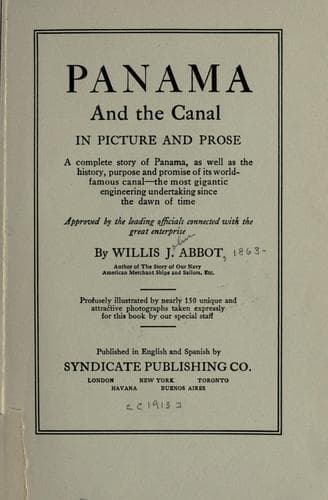
Panama and the Canal in Picture and Prose — John Shaqi
Panama and the Canal in Picture and ProseAbbot, Willis J. (Willis John)
History
Panama and the Canal in Picture and Prose
Abbot, Willis J. (Willis John)
Panama Canal (Panama) -- History
[Illustration: FIRE-FIGHTING FORCE AT CRISTOBAL]
Most of the people in Colon live over their stores and other places of
business, though back from the business section are a few comfortable
looking residences, and I noticed others being built on made land, as
though the beginnings of a mild “boom” were apparent. The newer houses
are of concrete, as is the municipal building and chief public school.
The Panama Railroad owns most of the land on which the town stands, and
to which it is practically limited, and the road is said to be
encouraging the use of cement or concrete by builders--an exceedingly
wise policy, as the town has suffered from repeated fires, in one of
which, in 1911, ten blocks were swept away and 1200 people left
homeless. The Isthmian Canal Commission maintains excellent
fire-fighting forces both in Cristobal and Ancon, and when the local
fire departments proved impotent to cope with the flames both of these
forces were called into play, the Ancon engines and men being rushed by
special train over the forty-five miles of railroad. Of course the fire
was in foreign territory, but the Republic of Panama did not resent the
invasion. Since that day many of the new buildings have been of
concrete, but the prevailing type of architecture may be described as a
modified renaissance of the mining shack.
[Illustration: THE NEW WASHINGTON HOTEL]
It is idle to look for points of interest in Colon proper. There are
none. But the history of the town though running over but sixty years is
full of human interest. It did not share with Panama the life of the
Spanish domination and aggression. Columbus, Balboa and the other
navigators sailed by its site without heed, making for Porto Bello or
Nombre de Dios, the better harbors. San Lorenzo, whose ruins stand at
the mouth of the Chagres River, looked down upon busy fleets, and fell
before the assaults of Sir Henry Morgan and his buccaneers while the
coral island that now upholds Colon was tenanted only by pelicans,
alligators and serpents. The life of man touched it when in 1850 the
American railroad builders determined to make it the Atlantic terminus
of the Panama road. Since then it never has lost nor will it lose a true
international importance.
[Illustration: THE ONLY STONE CHURCH IN COLON
The ritual is of the Church of England; the congregation almost wholly
Jamaica negroes]
Public-domain text, read in full here on John Shaqi.
Reviews
Reviews
No reviews yet
Be the first to share your thoughts on this work.
Join the Discussion
Join the discussion
Sign in to leave a comment or review.
Sign InorCreate an account