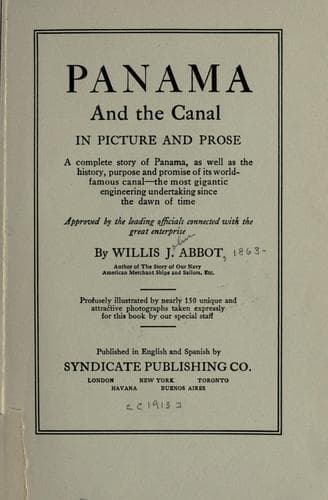
Panama and the Canal in Picture and ProseAbbot, Willis J. (Willis John)
History
Panama and the Canal in Picture and Prose
Abbot, Willis J. (Willis John)
Panama Canal (Panama) -- History
Manzanilla Island, on which the greater part of Colon now stands, was
originally a coral reef, on which tropical vegetation had taken root,
and died down to furnish soil for a new jungle until by the repetition
of this process through the ages a foot or two of soil raised itself
above the surface of the water and supported a swampy jungle. When the
engineers first came to locate there the beginnings of the Panama
railroad, they were compelled to make their quarters in an old sailing
ship in danger at all times of being carried out to sea by a norther. In
his “History of the Panama Railroad,” published in 1862, F. N. Otis
describes the site of the present city when first fixed thus:
[Illustration: NATURE OF COUNTRY NEAR COLON
Through this water-logged region the Panama railroad was built at heavy
cost in money and lives]
“This island cut off from the mainland by a narrow frith contained an
area of a little more than one square mile. It was a virgin swamp,
covered with a dense growth of the tortuous, water-loving mangrove, and
interlaced with huge vines and thorny shrubs defying entrance even to
the wild beasts common to the country. In the black slimy mud of its
surface alligators and other reptiles abounded, while the air was laden
with pestilential vapors and swarming with sandflies and mosquitoes.
These last proved so annoying to the laborers that unless their faces
were protected by gauze veils no work could be done even at midday.
Residence on the island was impossible. The party had their headquarters
in an old brig which brought down materials for building, tools,
provisions, etc., and was anchored in the bay.”
That was in May, 1850. In March, 1913, the author spent some time in
Colon. Excellent meals were enjoyed in a somewhat old-fashioned frame
hotel, while directly across the way the finishing touches were being
put to a new hotel, of reinforced concrete which for architectural taste
and beauty of position compares well with any seashore house in the
world. At the docks were ships of every nation; cables kept us in
communication with all civilized capitals. Not an insect of any sort was
seen, and to discover an alligator a considerable journey was necessary.
The completed Panama Railroad would carry us in three hours to the
Pacific, where the great water routes spread out again like a fan. In
half a century man had wrought this change, and with his great canal
will doubtless do more marvelous deeds in the time to come.
[Illustration: PANAMA POTTERY SELLERS]
Once construction of the road was begun shacks rose on piles amid the
swampy vegetation of the island. At certain points land was filled in
and a solid foundation made for machine shops. The settlement took a
sudden start forward in 1851 when a storm prevented two New York ships
from landing their passengers at the mouth of the Chagres River.
Public-domain text, read in full here on John Shaqi.
Reviews
Reviews
No reviews yet
Be the first to share your thoughts on this work.
Join the Discussion
Join the discussion
Sign in to leave a comment or review.
Sign InorCreate an account