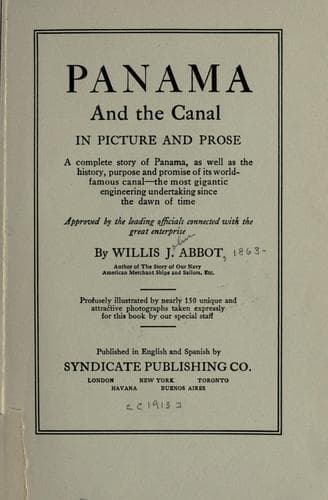
Panama and the Canal in Picture and ProseAbbot, Willis J. (Willis John)
History
Panama and the Canal in Picture and Prose
Abbot, Willis J. (Willis John)
Panama Canal (Panama) -- History
The delayed travelers were instead landed at Colon, and the rails having
been laid as far as Gatun, where the great locks now rise, they were
carried thither by the railroad. This route proving the more expeditious
the news quickly reached New York and the ships began making Colon their
port. As a result the town grew as fast and as unsubstantially as a
mushroom.
[Illustration: HINDOO LABORERS ON THE CANAL
At one time several hundred were employed but they are disappearing]
It was a floating population of people from every land and largely
lawless. The bard of the Isthmus has a poem too long to quote which
depicts a wayfarer at the gate of Heaven confessing to high crimes,
misdemeanors and all the sinful lusts of the flesh. At the close of the
damning confession he whispered something in the ear of the Saint, whose
brow cleared, and beaming welcome took the place of stern rejection. The
keeper of the keys according to the poet cried:
“Climb up, Oh, weary one, climb up!
Climb high! Climb higher yet
Until you reach the plush-lined seats
That only martyrs get.
Then sit you down and rest yourself
While years of bliss roll on.
Then to the angels he remarked,
‘_He’s been living in Colon!_’”
[Illustration: SAN BLAS BOATS AT EARLY DAWN]
With the completion of the Pacific railroads in the United States the
prosperity of Colon for a time waned. There was still business for the
railroad, as there has been to the present day, and as it is believed
there will be in the future despite the Canal. But the great rush was
ended. The eager men hurrying to be early at the place where gold was to
be found, and the men who had “made their pile” hastening home to spend
it, took the road across the plains. Colon settled down to a period of
lethargy for which its people were constitutionally well fitted. Once in
a while they were stirred up by reports of the projected Canal, and the
annual revolutions--President Roosevelt in a message to Congress noted
53 in 57 years--prevented life from becoming wholly monotonous. But
there was no sign of a renewal of the flush times of the gold rush until
late in the ’70’s the French engineers arrived to begin the surveys for
the Canal. By the way, that Isthmus from Darien to Nicaragua is probably
the most thoroughly surveyed bit of wild land in the world. Even on our
own Canal Zone where the general line of the Canal was early determined
each chief engineer had his own survey made, and most of the division
engineers prudently resurveyed the lines of their chiefs.
[Illustration: SAN BLAS INDIAN BOYS]
Public-domain text, read in full here on John Shaqi.
Reviews
Reviews
No reviews yet
Be the first to share your thoughts on this work.
Join the Discussion
Join the discussion
Sign in to leave a comment or review.
Sign InorCreate an account