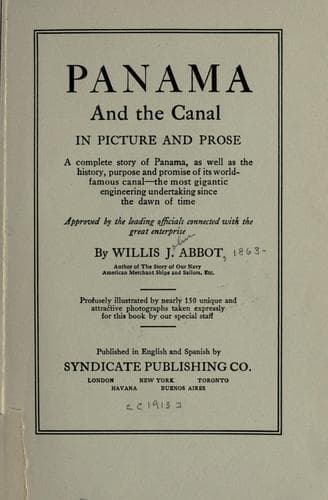
Panama and the Canal in Picture and ProseAbbot, Willis J. (Willis John)
History
Panama and the Canal in Picture and Prose
Abbot, Willis J. (Willis John)
Panama Canal (Panama) -- History
Public characters throng in Colon. A town with but sixty years of
history naturally abounds in early inhabitants. It is almost as bad as
Chicago was a few years ago when citizens who had reached the
“anecdotage” would halt you at the Lake Front and pointing to that
smoke-bedimmed cradle of the city’s dreamed-of future beauty would
assure you that they could have bought it all for a pair of boots--but
didn’t have the boots. One of the figures long pointed out on the
streets of Colon was an old colored man--an “ole nigger” in the local
phrase--who had been there from the days of the alligators and the
monkeys. He worked for the Panama Railroad surveyors, the road when
completed, the French and the American Canal builders. A sense of long
and veteran public service had invested him with an air of dignity
rather out of harmony with his raiment. “John Aspinwall” they called
him, because Aspinwall was for a time the name of the most regal
significance on the island. The Poet of Panama immortalized him in verse
thus:
“Oh, a quaint old moke, is John Aspinwall,
Who lives by the Dead House gate,
And quaint are his thoughts, if thoughts at all
Ever lurk in his woolly pate,
For he’s old as the hills is this coal-black man,
Thrice doubled with age is he,
And the days when his wanderings first began
Are shrouded in mystery.”
[Illustration: BACHELOR QUARTERS AT TORO POINT]
If you keep a shrewd and watchful eye on the balconies above the cheap
john stores you will now and again catch a little glimpse reminiscent of
Pekin. For the Chinese like to hang their balconies with artistic
screens, bedeck them with palms, illuminate them with the gay lanterns
of their home. Sometimes a woman of complexion of rather accentuated
brunette will hang over the rail with a Chinese--or at least a
Chinesque--baby in the parti-colored clothing of its paternal ancestors.
Or as you stroll along the back or side streets more given over to
residences, an open door here and there gives a glimpse of an interior
crowded with household goods--and household gods which are babies. Not
precisely luring are these views. They suggest rather that the daily
efforts of Col. Gorgas to make and keep the city clean might well have
extended further behind the front doors of the house. They did to a
slight degree, of course, for there was fumigation unlimited in the
first days of the great cleaning up, and even now there is persistent
sanitary inspection. The Canal Zone authorities relinquished to the
Panama local officials the paving and sanitation work of the city, but
retained it in Colon, which serves to indicate the estimate put upon the
comparative fitness for self government of the people of the two towns.
[Illustration: A COLON WATER CARRIER]
Public-domain text, read in full here on John Shaqi.
Reviews
Reviews
No reviews yet
Be the first to share your thoughts on this work.
Elsewhere in the archive
Join the Discussion
Join the discussion
Sign in to leave a comment or review.
Sign InorCreate an account