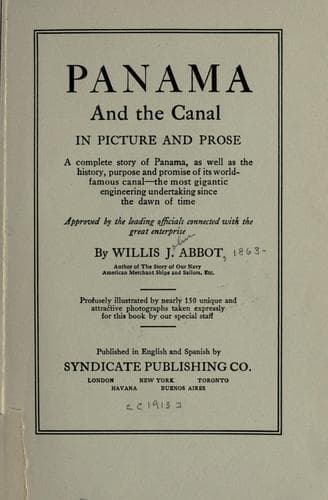
Panama and the Canal in Picture and ProseAbbot, Willis J. (Willis John)
History
Panama and the Canal in Picture and Prose
Abbot, Willis J. (Willis John)
Panama Canal (Panama) -- History
Down by the docks, if one likes the savor of spices and the odor of tar,
you find the real society of the Seven Seas. Every variety of ship is
there, from the stately ocean liner just in from Southampton or Havre to
the schooner-rigged cayuca with its crew of San Blas Indians, down from
their forbidden country with a cargo of cocoanuts, yams and bananas. A
curious craft is the cayuca. Ranging in size from a slender canoe twelve
feet long and barely wide enough to hold a man to a considerable craft
of eight-foot beam and perhaps 35 to 40 feet on the water line, its many
varieties have one thing in common. Each is hewn out of a single log.
Shaped to the form of a boat by the universal tool, the machete, and
hollowed out partly by burning, partly by chipping, these great logs are
transformed into craft that in any hands save those of the Indians bred
to their use, would be peremptory invitations to a watery death. But the
San Blas men pole them through rapids on the Chagres that would puzzle a
guide of our North Woods, or at sea take them out in northers that keep
the liner tied to her dock. Some of these boats by the way are hollowed
from mahogany logs that on the wharf at New York or Boston would be
worth $2,000.
[Illustration: AN OPEN SEWER IN A COLON STREET]
The history of the Panama Railroad may well be briefly sketched here.
For its time it was the most audacious essay in railway building the
world had known, for be it known it was begun barely twenty years after
the first railroad had been built in the United States and before either
railroad engineers or railroad labor had a recognized place in industry.
The difficulties to be surmounted were of a sort that no men had
grappled with before. Engineers had learned how to cut down hills,
tunnel mountains and bridge rivers, but to build a road bed firm enough
to support heavy trains in a bottomless swamp; to run a line through a
jungle that seemed to grow up again before the transit could follow the
axe man; to grapple with a river that had been known to rise forty feet
in a day; to eat lunch standing thigh deep in water with friendly
alligators looking on from adjacent logs, and to do all this amid the
unceasing buzz of venomous insects whose sting, as we learned half a
century later, carried the germs of malaria and yellow fever--this was a
new draft upon engineering skill and endurance that might well stagger
the best. The demand was met. The road was built, but at a heavy cost of
life. It used to be said that a life was the price of every tie laid,
but this was a picturesque exaggeration. About 6000 men in all died
during the construction period.
[Illustration: BY A COCLÉ BROOK]
Public-domain text, read in full here on John Shaqi.
Reviews
Reviews
No reviews yet
Be the first to share your thoughts on this work.
Elsewhere in the archive
Join the Discussion
Join the discussion
Sign in to leave a comment or review.
Sign InorCreate an account