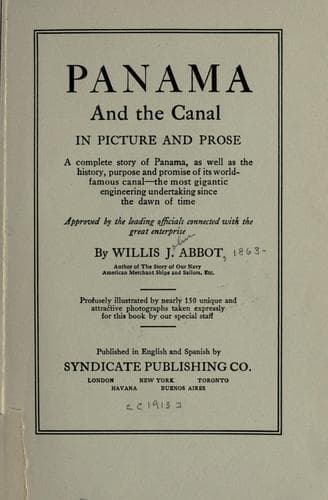
Panama and the Canal in Picture and ProseAbbot, Willis J. (Willis John)
History
Panama and the Canal in Picture and Prose
Abbot, Willis J. (Willis John)
Panama Canal (Panama) -- History
Some thrust sharpened sticks
through their throats, or clutching great stones leaped into the river
maintaining their hold until death made the grasp still more rigid. Some
starved themselves and others died of mere brooding over their dismal
state. In a few weeks but 200 were left alive, and these were sent to
Jamaica where they were slowly absorbed by the native population. On the
line of the old Panama Railroad, now abandoned and submerged by the
waters of Gatun Lake, was a village called Matachin, which local
etymologists declare means “dead Chinaman,” and hold that it was the
scene of this melancholy sacrifice of oriental life.
[Illustration: Copyright, 1913, F. E. Wright.
GOING TO MARKET
Jamaica country roads are gay with women in brightly colored dresses,
carrying the products of their little farms to market. The burden is
always borne on the head with the result that peasant women have a
graceful and even stately carriage.]
The railroad builders soon found that the expense of the construction
would vastly exceed their estimates. The price of a principality went
into the Black Swamp, the road bed through which was practically floated
on a monster pontoon. It is not true, as often asserted, that engines
were sunk there to make a foundation for the road, but numbers of flat
cars were thus employed to furnish a floating foundation. The swamp
which impeded the progress of the road was about five miles south of
Gatun and was still giving trouble in 1908, when the heavier American
rolling stock was put upon the road. Soundings then made indicate that
the solid bottom under the ooze is 185 feet below the surface, and
somewhere between are the scores of dump cars and the thousands of tons
of rock and earth with which the monster has been fed. The Americans
conquered it, apparently, in 1908, by building a trestle and filling it
with cinders and other light material. But every engineer was glad when
in 1912 the relocation of the road abandoned the Black Swamp to its
original diabolical devices.
[Illustration: A PICTURESQUE INLET OF THE CARIBBEAN]
Public-domain text, read in full here on John Shaqi.
Reviews
Reviews
No reviews yet
Be the first to share your thoughts on this work.
Elsewhere in the archive
Join the Discussion
Join the discussion
Sign in to leave a comment or review.
Sign InorCreate an account