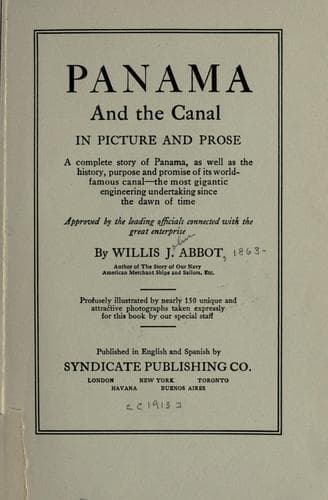
Panama and the Canal in Picture and ProseAbbot, Willis J. (Willis John)
History
Panama and the Canal in Picture and Prose
Abbot, Willis J. (Willis John)
Panama Canal (Panama) -- History
Henry Clay justified his far-sightedness by securing in 1835 the
creation of a commission to consider the practicability of a
trans-isthmian railroad. A commissioner was appointed, secured a
concession from what was then New Granada, died before getting home, and
the whole matter was forgotten for ten years. In this interim the
French, for whom from the earliest days the Isthmus had a fascination,
secured a concession but were unable to raise the money necessary for
the road’s construction. In 1849 three Americans who deserve a place in
history, William H. Aspinwall, John L. Stevens and Henry Chauncy,
secured a concession at Bogota and straightway went to work.
Difficulties beset them on every side. The swamp had no bottom and for a
time it seemed that their financial resources had a very apparent one.
But the rush for gold, though it greatly increased the cost of their
labor, made their enterprise appear more promising to the investing
public and their temporary need of funds was soon met.
[Illustration: THE MANGROVES MARCHING ON STILT-LIKE ROOTS]
But the swamp and jungle were unrelenting in their toll of human life.
Men working all day deep in slimy ooze composed of decaying tropical
vegetation, sleeping exposed to the bites of malaria-bearing insects,
speedily sickened and too often died. The company took all possible care
of its workmen, but even that was not enough. Working men of every
nationality were experimented with but none were immune. The historian
of the railroad reported that the African resisted longest, next the
coolie, then the European, and last the Chinese. The experience of the
company with the last named class of labor was tragic in the extreme.
Eight hundred were landed on the Isthmus after a voyage on which sixteen
had died. Thirty-two fell ill almost at the moment of landing and in
less than a week eighty more were prostrated. Strangers in a strange
land, unable to express their complaints or make clear their symptoms,
they were almost as much the victims of homesickness as of any other
ill. The interpreters who accompanied them declared that much of their
illness was due to their deprivation of their accustomed opium, and for
a time the authorities supplied them, with the result that nearly
two-thirds were again up and able to work. Then the exaggerated
American moral sense, which is so apt to ignore the customs of other
lands and peoples, caused the opium supply to be shut off. Perhaps the
fact that the cost of opium daily per Chinaman was 15 cents had
something to do with it. At any rate the whole body of Chinamen were
soon sick unto death and quite ready for it. They made no effort to
cling to the lives that had become hateful. Suicides were a daily
occurrence and in all forms. Some with Chinese stolidity would sit upon
a rock on the ocean’s bed and wait for the tide to submerge them. Many
used their own queues as ropes and hanged themselves. Others persuaded
or bribed their fellows to shoot them dead.
Public-domain text, read in full here on John Shaqi.
Reviews
Reviews
No reviews yet
Be the first to share your thoughts on this work.
Elsewhere in the archive
Join the Discussion
Join the discussion
Sign in to leave a comment or review.
Sign InorCreate an account