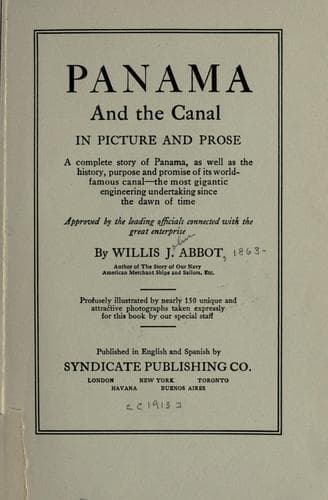
Panama and the Canal in Picture and ProseAbbot, Willis J. (Willis John)
History
Panama and the Canal in Picture and Prose
Abbot, Willis J. (Willis John)
Panama Canal (Panama) -- History
Too much prosperity brought indifference and lax management and the
finances of the road were showing a decided deterioration when the
French took up the Canal problem. One of the chief values of the
franchise granted by New Granada and afterward renewed by Colombia was
the stipulation that no canal should be built in the territory without
the consent of the railroad corporation. With this club the directors
forced the French to buy them out, and when the rights of the French
Canal company passed to the United States we acquired the railroad as
well.
[Illustration: THE SOULFUL EYES OF THE TROPICS]
It is now Uncle Sam’s first essay in the government ownership and
operation of railroads. Extremists declare that his success as a manager
is shown by the fact that he takes a passenger from the Atlantic to the
Pacific in three hours for $2.40, while the privately owned Pacific
railroads take several days and charge about $75 to accomplish the same
result. There is a fallacy in this argument somewhere, but there is none
in the assertion that by government officials the Panama Railroad is run
successfully both from the point of service and of profits. Its net
earnings for the fiscal year of 1912 were $1,762,000, of which about
five-sixths was from commercial business. But it must be remembered that
in that year the road was conducted primarily for the purpose of Canal
building--everything was subordinated to the Big Job. That brought it
abnormal revenue, and laid upon it abnormal burdens. The record shows
however that it was directed with a singular attention to detail and
phenomenal success. When passenger trains must be run so as never to
interfere with dirt trains, and when dirt trains must be so run that a
few score steam-shovels dipping up five cubic yards of broken rock at a
mouthful shall never lack for a flat car on which to dump the load, it
means some fine work for the traffic manager. The superintendent of
schools remarked to me that the question whether a passenger train
should stop at a certain station to pick up school children depended on
the convenience of certain steam-shovels and that the matter had to be
decided by Col. Goethals. Which goes to show that the Colonel’s
responsibilities are varied--but of that more anon, as the story-tellers
say.
[Illustration: MARKET DAY AT DAVID]
Public-domain text, read in full here on John Shaqi.
Reviews
Reviews
No reviews yet
Be the first to share your thoughts on this work.
Elsewhere in the archive
Join the Discussion
Join the discussion
Sign in to leave a comment or review.
Sign InorCreate an account