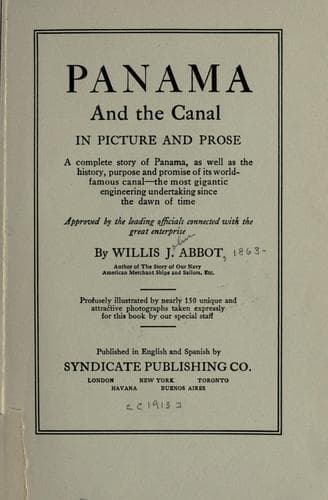
Panama and the Canal in Picture and ProseAbbot, Willis J. (Willis John)
History
Panama and the Canal in Picture and Prose
Abbot, Willis J. (Willis John)
Panama Canal (Panama) -- History
Within a few years forty miles of the Panama Railroad have been
relocated, the prime purpose of the change being to obviate the
necessity of crossing the Canal at any point. One of the witticisms of
the Zone is that the Panama is the only railroad that runs crosswise as
well as lengthwise. This jest is partly based on the fact that
nine-tenths of the line has been moved to a new location, but more on
the practice of picking up every night or two some thousand feet of
track in the Canal bed and moving it bodily, ties and all, some feet to
a new line. This is made necessary when the steam-shovels have dug out
all the rock and dirt that can be reached from the old line, and it is
accomplished by machines called track shifters, each of which
accomplishes the work of hundreds of men.
[Illustration: SCENE ON ALMIRANTE BAY]
The Panama Railroad is today what business men call a going concern. But
it is run with a singular indifference to private methods of railroad
management. It has a board of directors, but they do little directing.
Its shares do not figure in Wall Street, and we do not hear of it
floating loans, scaling down debts or engaging in any of the
stock-jobbing operations which in late years have resulted in railroad
presidents being lawyers rather than railroad men. The United States
government came into possession of a railroad and had to run it. Well?
The government proved equal to the emergency and perhaps its experience
will lead it to get possession of yet other railroads.
CHAPTER III
NOMBRE DE DIOS, PORTO BELLO AND SAN LORENZO
Within twenty miles, at the very most, east and west of Colon lie the
chief existing memorials of the bygone days of Spanish discovery and
colonization, and English adventurous raids and destruction, on the
Isthmus. All that is picturesque and enthralling--that is to say, all
that is stirring, bloody, and lawless--in the history of the Caribbean
shore of the Isthmus lies thus adjacent to the Atlantic entrance of the
Canal. To the east are Nombre de Dios and Porto Bello--the oldest
European settlements on the North American continent, the one being
founded about 1510, almost a century and a half before the landing at
Plymouth, and the other in 1607, the very year of the planting of
Jamestown, Virginia. To the west is the castle of San Lorenzo at the
mouth of the Chagres, the gateway to the Pacific trade, built in the
latter years of the sixteenth century and repeatedly destroyed. About
these Spanish outposts, once thriving market towns and massive
fortresses, but now vine-covered ruins where “the lion and the lizard
keep their court” clusters a wealth of historical lore.
Public-domain text, read in full here on John Shaqi.
Reviews
Reviews
No reviews yet
Be the first to share your thoughts on this work.
Elsewhere in the archive
Join the Discussion
Join the discussion
Sign in to leave a comment or review.
Sign InorCreate an account