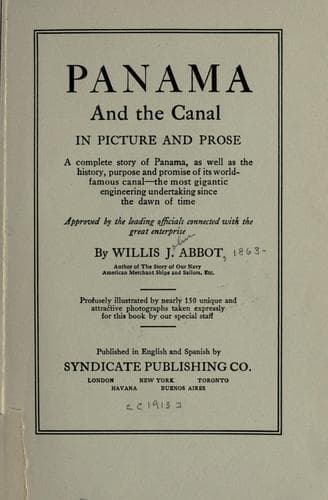
Panama and the Canal in Picture and ProseAbbot, Willis J. (Willis John)
History
Panama and the Canal in Picture and Prose
Abbot, Willis J. (Willis John)
Panama Canal (Panama) -- History
“For fifteen days the revel was maintained, every citizen who looked as
if he had money being put to the torture to compel him to confess where
he had hidden it. When all had been extorted that seemed possible the
buccaneers made ready to depart. But first Morgan demanded 100,000
pieces of eight, in default of which he would burn the city and blow up
the castles. The wretched citizens sought aid of the President of Panama
who was as unwilling to help them with gold as with powder and lead. In
some miraculous way they raised it, and Morgan and his men departed,
making their way to that town of revelry, Port Royal, of which I have
already spoken, at the entrance to Kingston harbor. Perhaps it is fair
to contrast with Esquemeling’s story of the exploit Morgan’s official
report--for this worthy had a royal commission for his deeds. The
Captain reported that he had left Porto Bello in as good condition as he
found it, that its people had been well treated, so much so that
“several ladies of great quality and other prisoners who were offered
their liberty to go to the President’s camp refused, saying they were
now prisoners to a person of quality who was more tender of their honors
than they doubted to find in the President’s camp; and so voluntarily
continued with him.”
[Illustration: A GROUP OF CUEPA TREES]
Captain Morgan’s own testimony to his kindness to prisoners and his
regard for female honor impresses one as quite as novel and audacious as
his brilliant idea of forcing priests and nuns to carry the scaling
ladders with which to assault a fortress defended by devout Catholics.
Yet except for little incidents of this sort the whole crew--Spanish
conquistadores, French filibusters and British buccaneers--were very
tenacious of the forms of religion and ostentatious piety. The Spaniards
were always singing Te Deums, and naming their engines of war after the
saints; Captain Daniels, a French filibuster, shot dead a sailor for
irreverent behavior during mass; the English ships had divine service
every Sunday and profanity and gambling were sometimes prohibited in the
enlistment articles. All of which goes to show that people may be very
religious and still a pest to humanity--nor is it necessary to turn to
the buccaneers for instances of this fact.
CHAPTER IV
SAN LORENZO AND PANAMA
Public-domain text, read in full here on John Shaqi.
Reviews
Reviews
No reviews yet
Be the first to share your thoughts on this work.
Elsewhere in the archive
Join the Discussion
Join the discussion
Sign in to leave a comment or review.
Sign InorCreate an account