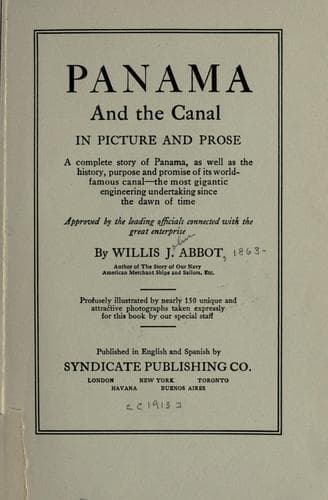
Panama and the Canal in Picture and ProseAbbot, Willis J. (Willis John)
History
Panama and the Canal in Picture and Prose
Abbot, Willis J. (Willis John)
Panama Canal (Panama) -- History
The visitor to Colon should not fail, before crossing to the Pacific
side of the Isthmus, to visit the ruins of the Castle of San Lorenzo.
The trip is not an easy one, and must usually be arranged for in
advance, but the end well repays the exertion. The easiest way, when the
weather permits, is to charter a tug or motor boat and make the journey
by sea--a trip of two or three hours at most. But the Caribbean is a
tempestuous and a treacherous sea. One may wait days for weather
permitting the trip to be made in comfort, and even then may find a
stormy afternoon succeed to a calm morning. For this reason it is
essential that a seaworthy boat be procured and, if not essential, very
desirable that the company be not subject to the qualms of seasickness.
[Illustration: _Photo by T. J. Marine_
THE SALLY-PORT AT SAN LORENZO
An unusual picture because of the clearing away of the jungle.
Ordinarily the walls are hidden]
To my mind the more interesting way to visit the ruins is to take the
railroad out to Gatun, and there at the very base of the roaring
spillway, board a power boat and chug down the sluggish Chagres to the
river’s mouth where stands the ancient fort. The boats obtainable are
not of the most modern model and would stand a slender chance in speed
contests. But in one, however slow, you are lost to all appearance of
civilization five minutes after you cast off from the clay bank. At
Gatun, the canal which has been carried through the artificial lake made
by damming the Chagres River, turns sharply away from that water course
on the way to the new port of Balboa. The six or eight miles of the
tropical river which we are to traverse have been untouched by the
activities of the canal builders. The sluggish stream flows between
walls of dense green jungle, as silent as though behind their barrier
only a mile or two away there were not men by the thousands making great
flights of aquatic steps to lift the world’s ocean carriers over the
hills. Once in awhile through the silent air comes the distant boom of a
blast in Culebra, only an infrequent reminder of the presence of
civilized man and his explosive activities. Infrequent though it is,
however, it has been sufficient to frighten away the more timid
inhabitants of the waterside--the alligators, the boas and the monkeys.
Only at rare intervals are any of these seen now, though in the earlier
days of the American invasion the alligators and monkeys were plentiful.
Today the chief signs of animal life are the birds--herons, white and
blue, flying from pool to pool or posing artistically on logs or in
shallows; great cormorant ducks that fly up and down midstream,
apparently unacquainted with the terrors of the shotgun; kingfishers in
bright blue and paroquets in gaudy colors. The river is said to be full
of fish, including sharks, for the water is saline clear up to the Gatun
locks.
Public-domain text, read in full here on John Shaqi.
Reviews
Reviews
No reviews yet
Be the first to share your thoughts on this work.
Elsewhere in the archive
Join the Discussion
Join the discussion
Sign in to leave a comment or review.
Sign InorCreate an account