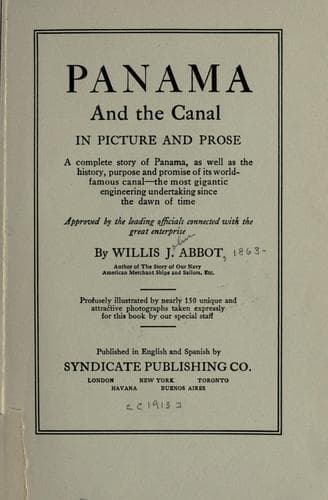
Panama and the Canal in Picture and ProseAbbot, Willis J. (Willis John)
History
Panama and the Canal in Picture and Prose
Abbot, Willis J. (Willis John)
Panama Canal (Panama) -- History
Nor did the English win their triumph easily. Their force was in the
neighborhood of 400, of whom more than 100 were killed and 70 wounded. A
round shot took off both legs of Colonel Bradley and from the wound he
died a few days later. The church of the castle was turned into a
hospital, the Spaniards were made to bury their own dead, which was done
by dropping them over the cliff into the sea, and word was sent to
Morgan that the way was clear for his march upon Panama.
* * * * *
We may for a time turn aside from Buccaneer Morgan and his ravenous raid
to consider the later history of the two strongholds--Porto Bello and
San Lorenzo--which lie to the east and west of Colon. It was not the
rude shock of war which reduced them to the state of desolation and ruin
in which visitors now find them--though of such shocks they certainly
experienced enough. Morgan on his return from Panama blew up San Lorenzo
and left it a wreck, but the Spaniards rebuilt it stronger than ever
and it long continued to mount guard over the entrance to the Chagres.
So too with the forts at Porto Bello. But about 1738 one Edward Vernon,
after whom it is said Mount Vernon, the home of Washington, was named,
rose in the English parliament and declared that he could take Porto
Bello with only six ships. Parliament took him at his word, commissioned
him admiral, gave him seven ships and dispatched him on the enterprise.
Being a gentleman of spirit and a true sport, Admiral Vernon, on
approaching the Isthmus, sent one of his ships into other waters,
“disdaining to appear before Porto Bello with one ship more than he had
engaged to take it with.” Success came to him with ease. Only four of
his ships were engaged and the only considerable loss was among a
landing party which stormed the lower battery of the Iron Fort. The
Spaniards showed but little stomach for the fight, and it is worth
noting that in the recurrent affrays in the West Indies and Central
America the English whipped them with the same monotonous certainty with
which the latter had beaten the Indians. Any one desiring to draw broad
generalizations as to the comparative courage of nations is welcome to
this fact.
[Illustration: WOMAN OF THE CHAGRES REGION]
Public-domain text, read in full here on John Shaqi.
Reviews
Reviews
No reviews yet
Be the first to share your thoughts on this work.
Elsewhere in the archive
Join the Discussion
Join the discussion
Sign in to leave a comment or review.
Sign InorCreate an account