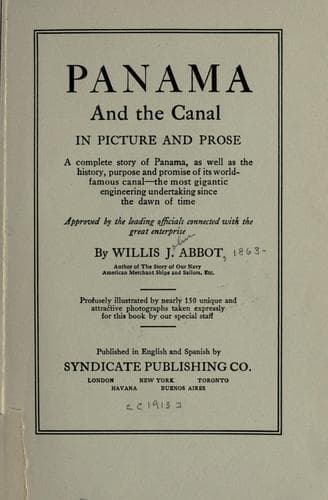
Panama and the Canal in Picture and ProseAbbot, Willis J. (Willis John)
History
Panama and the Canal in Picture and Prose
Abbot, Willis J. (Willis John)
Panama Canal (Panama) -- History
The Spanish plan of battle savored largely of the theatrical. As the
circus opens its performance with a grand entry of mounted performers,
so the Spaniards ushered in the fight with a grand charge of cavalry.
Admirable cavalrymen, they are said to have been, well mounted on
trained cattle ponies and in all about 400 strong. Unhappily there
appeared to have been no preliminary study of the English position, and
a morass impenetrable by horsemen guarded its flanks. Only in front
could the English line be reached and there the trained marksmen of the
buccaneers, or cattle hunters, dropping on one knee, picked off the
Spanish horsemen before they could close. The cavalry hardly reached the
buccaneers’ first line though they charged twice with the utmost
gallantry. An infantry charge that followed was beaten back with like
slaughter. Seeing this the Spaniards are said to have resorted to a
device as ridiculous in its outcome as it was in its conception. This
was the driving against the buccaneers’ lines of a herd of a thousand
bulls driven by fifty vaqueros. With great shouting and cracking of
whips the herd was urged against the invaders. But the Central American
bull as a ferocious beast is a disappointment--which perhaps explains
the placidity with which Panama agreed to the request of the United
States that it abolish bull fighting. If not vicious, however, they can
be obstinate, and about as many bulls charged into the already shattered
Spanish lines as upon the buccaneers. Morgan showed quick wit by
ordering his men to let the bulls pass, but kill the vaqueros, and so,
with the exception of a few bovines who lingered to rend the British
flags, being enraged by their scarlet hue, the greater part of the herd
trotted off to a quieter part of the savanna where they might placidly
graze while the foolish men who had sought to drag them into the quarrel
went on killing each other. This virtually ended the Spanish defense.
After another charge the defenders of the city gave up any effort at
organized opposition to the invaders and fled into the city, or to the
shelter of the neighboring jungle. The English, exhausted with their
long march and the shock of the battle, did not immediately follow up
their advantage but rested for some hours. There is much conflict of
authority on the question of loss in the battle. Morgan claimed to have
lost only five men killed and ten wounded, and fixed the Spanish loss at
about 400. Esquemeling says there were 600 Spaniards dead upon the
field beside the wounded and prisoners. Whatever the comparative losses
the Spanish defeat was decisive, nor did the survivors regain sufficient
morale to offer any effective opposition to the buccaneers as they moved
upon the city.
[Illustration: IN THE CRYPT OF OLD SAN AUGUSTINE]
[Illustration: A WOMAN OF OLD PANAMA]
Public-domain text, read in full here on John Shaqi.
Reviews
Reviews
No reviews yet
Be the first to share your thoughts on this work.
Elsewhere in the archive
Join the Discussion
Join the discussion
Sign in to leave a comment or review.
Sign InorCreate an account