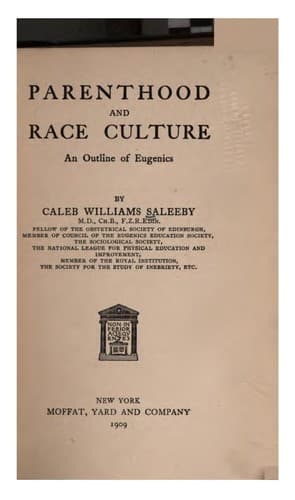
Parenthood and Race Culture: An Outline of EugenicsSaleeby, C. W. (Caleb Williams)
Philosophy
Parenthood and Race Culture: An Outline of Eugenics
Saleeby, C. W. (Caleb Williams)
Eugenics
Perhaps we are wrong in principle also, since that which exists for
parenthood, and without which the continuance and future terrestrial
hope of mankind is impossible, cannot be animal and low, unless human
life, even at its best attained or attainable, be animal and low. Our
business rather is to treat this great fact in a spirit worthy of the
purpose for which it exists; and therefore, as part of that process of
education by which we desire to make the young into reasonable, moral
and fully human beings, to teach explicitly, without unworthy shame,
that this thing exists for the highest of purposes that nothing which
the future holds for boy or girl can conceivably be higher or happier
than worthy parenthood, however commonplace that may appear to common
eyes, and that accordingly this instinct is to be guarded, treated,
used, honoured as for parenthood, a fact which immediately raises it
from the egoistic to the altruistic plane. We have to learn and to
teach that worthy parenthood is the highest end which education can
achieve--highest alike on the ground of its services to the individual
and its services to the future, and the relation of the racial instinct
to parenthood being what it is, we have to look upon it in that light,
at once austere and splendid.
In the teaching of girls, only a false and disastrous prudery offers
any great obstacle. The idea of motherhood is essentially natural to
the normal girl. It is the eugenic education of boys that is more
difficult, and the possibility of which will be questioned in some
quarters, especially by those who regard the type of boy evolved in
semi-monastic institutions, devoid of feminine influence, as a normal
and unchangeable being. Co-educationists, however, are teaching us
to revise that opinion, and will yet demonstrate, perhaps, that the
inculcation of the idea of fatherhood is not so impossible nor so
alien to the boy nature as some would suppose. If such a duty devolved
upon the present writer, he would feel inclined, perhaps, to present
his teaching in terms of patriotism. He would urge that “there is no
wealth but life”; that nations are made not of provinces nor property
but of people; that modern biology is teaching historians to explain
such phenomena as the fall of Rome in terms of the quality of the
national life; that therefore, individuals being mortal, parenthood
necessarily takes its place as the supreme factor of national destiny;
that the true patriotism must therefore concern itself with the
conditions and the quality of parenthood--much less with its quantity;
that the patriotism which ignores these truths is ignorant and must be
disastrous; that we must turn our attention therefore from flag waving
to questions of individual conduct; that if alcohol and syphilis,
for instance, can be demonstrated to be what I would call racial
poisons, the young patriot must make himself aware of their relation to
parenthood, and must act upon his knowledge of that relation. It can
Public-domain text, read in full here on John Shaqi.
Reviews
Reviews
No reviews yet
Be the first to share your thoughts on this work.
Elsewhere in the archive
Join the Discussion
Join the discussion
Sign in to leave a comment or review.
Sign InorCreate an account