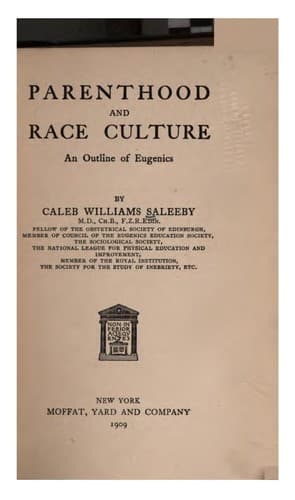
Parenthood and Race Culture: An Outline of EugenicsSaleeby, C. W. (Caleb Williams)
Philosophy
Parenthood and Race Culture: An Outline of Eugenics
Saleeby, C. W. (Caleb Williams)
Eugenics
A chapter must be included here concerning a question which can never
safely be ignored in any consideration of race-culture, but the
importance of which, as I think I see it, is recognised by no one
who has concerned himself at all with this subject, from Mr. Francis
Galton himself downwards. We must all be agreed, Mr. Galton declares,
as to the propriety of breeding, if it be possible, for health, energy
and ability, whatever else may be doubtful. To this I would add that,
whether we are agreed or not, we must breed for motherhood, and that,
even if we do not, we shall have to reckon with it. The general eugenic
position, I fancy, is that the requirements which we should make of
both sexes, the mothers of the future as well as the fathers, are
essentially identical: but it seems to me that we have not yet reckoned
with the vast importance of motherhood as a factor in the evolution
of all the higher species of animals, and its absolute supremacy,
inevitable and persistent whether recognised or ignored, in the case of
man. Any system of eugenics or race-culture, any system of government,
any proposal for social reform--as, for instance, the reduction of
infant mortality--which fails to reckon with motherhood or falls
short of adequately appraising it, is foredoomed to failure and will
continue to fail so long as the basal facts of human nature and the
development of the human individual retain even approximately their
present character. Whatever proposals for eugenics or race-culture be
made or carried out, the fact will remain that the race is made up of
mortal individuals; that every one of these begins its visible life as
a helpless baby, and that the system which does not permit the babies
to survive, _they_ will not permit to survive.
Public-domain text, read in full here on John Shaqi.
Reviews
Reviews
No reviews yet
Be the first to share your thoughts on this work.
Elsewhere in the archive
Join the Discussion
Join the discussion
Sign in to leave a comment or review.
Sign InorCreate an account