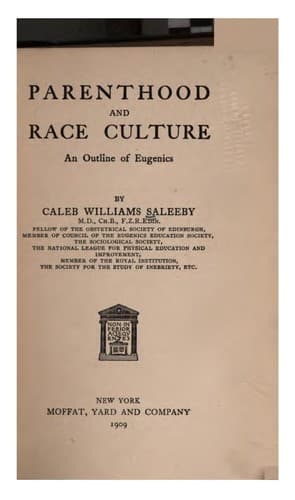
Parenthood and Race Culture: An Outline of EugenicsSaleeby, C. W. (Caleb Williams)
Philosophy
Parenthood and Race Culture: An Outline of Eugenics
Saleeby, C. W. (Caleb Williams)
Eugenics
=Motherhood and intelligence.=--We have maintained that the vital
character which is of supreme survival-value for man is his
intelligence, and this, as we know, is his unique possession. It is
very largely for intelligence, therefore, that race-culture or eugenics
proposes, if possible, to work. But if there be certain conditions
which must be complied with before intelligence can possibly be
evolved, eugenics will come to disaster should it ignore them. These
conditions do exist, and have hitherto been entirely ignored by all
students of this question. Let certain great facts be observed.
Why is the human baby the most helpless of all creatures? Since it is
to become the most capable, should it not, even in its infant state,
show signs of its coming superiority? What is the meaning of this
paradox?
The answer is that, so far as physical weapons of offence and defence
are concerned, these have disappeared because intelligence makes them
superfluous or even burdensome. But the peculiar helplessness of the
human infant depends not upon its nakedness in the physical sense but
upon its lack of very nearly all instinctive capacities. It is this
absence of effective instincts which distinguishes the baby from the
young of all other creatures. Why should its endowment in this respect
be so inferior?
It is because of the fact that, if instinct is to give rise to
intelligence, it must be plastic. A purely instinctive creature reacts
to certain sets of circumstances in certain effortless, perfect and
fixed ways. The reactions are the whole of its psychical life. They
need no education, being as perfectly performed on the first occasion
as on the last, and in many instances being performed only once in the
whole history of the creature in question. But, on the other hand, they
are almost incapable of education, and even in the cases where they
lack absolute perfection at first, they only require the merest modicum
of opportunity in order to acquire it. Perfect within their limits,
they are yet most definitely limited. They never achieve the new,
they are utterly at fault in novel circumstances, and they are wholly
incapable of creating circumstances.
A creature cannot be at once purely instinctive and intelligent. An
instinctive action is simply a compound reflex action, a highly adapted
automatism: now automatism and intelligence are necessarily inversely
proportional. It is possible for an intelligent creature to acquire
automatisms, which are popularly described as instinctive. They are
not instincts, however, but the acquired equivalents of instincts:
“secondary automatisms.” If they are used to replace intelligence, the
individual, in so far, sinks from the human to the sub-human level.
Their proper function is to leave the intelligence free for higher
purposes more worthy of it than, say, the act of dressing oneself.
Public-domain text, read in full here on John Shaqi.
Reviews
Reviews
No reviews yet
Be the first to share your thoughts on this work.
Elsewhere in the archive
Join the Discussion
Join the discussion
Sign in to leave a comment or review.
Sign InorCreate an account